Tuesday, July 1, 2025

2026 Special - Kendo Rage


Everything wants you dead!
Oh, and you're going to be late for school.

That's the basic premise behind Kendo Rage, a hack & slash platformer where you rush through waves of ghosts and maniacal wildlife. At the end of each round, you'll contend with a vicious rival. Time is not on your side. You'll get bad endings if you're late... not that the good ending is much better. The difference between the two is mostly a matter of pride, something you'll need a bit of survive this adventure. What we have here is a video game that's very lean, but also a bit unforgiving. It was the style at the time. Release a game that most players can somewhat easily survive until the last level, then throw them in "the grinder". For some, it's an opportunity to push their gaming skills to new heights. Others will succumb to frustration and possibly rage. 

Sounds like fun, doesn't it?


Before going much further, I confess that maybe "somewhat easily" is lifting more than it should. As early as the first level, players will quickly realize that their adventure will not be a forgiving one. Josephine is about as squishy as the average Belmont. Four hits are all it takes to bring her from full health to full death. Enemies are also a bit more plentiful than the typical Castlevania and not afraid to attack from multiple directions at once. They don't respawn when killed, which is appreciated. The catch of course is the clock, doing psyche damage with every tick. Logically, you'll have a better chance of success if you play slow and methodically. That tends to fly out the window when you glance at the clock. At that moment, the urge to hurry along gets the better of you. Before you realize it, you've bumped into an enemy, lost your rhythm while dodging a series of attacks, or flat-out lost a life. 

Again, the difference between endings is so miniscule that being late should mean nothing. There's something about video games though, how they make players commit to multiple play-throughs and deal with waves of emotions, all with just a line of text. The 16-bit era was particularly egregious. Several ending screens will tell you "Not bad. Now play normal mode." and then "Good job. Now play hard mode." and then "Great job. Now play very hard mode." and then "Fantastic job! Now play maniac mode." only to finally be told "Congratulations, maniac." Josephine being late for school doesn't lead to the end of the world. Nevertheless, the clock influences every action, compounding the player's chances of actually reaching the end. "It's a marathon, not a sprint." I tell myself repeatedly while myself repeatedly tells I to shut the hell up with the "loser" talk. Needless to say, we tried to rush through Kendo Rage and suffered for it. 


The first boss sets the pace that should be followed: measured and consistent. Her attacks have a very clear pattern, punishing anyone who gets greedy with trying to land more hits. One thing that will become apparent before long is that while most enemies are crushed in 1 or a few hits, bosses get progressively more durable with every passing level. It's a tricky balance, designing a boss that takes a lot of hits but doesn't require a long time to defeat. I think the game is mostly successful at it. Players are encouraged to stay back and watch for openings. 

Future levels play out in similar fashion. The locales and sometimes the architecture will change, but most time in levels are spent hacking through a bunch of foes while engaging with fairly basic platforming. A couple gimmicks come into play like the requisite underwater and auto-scroller levels. Getting around isn't the worrisome part, especially since there aren't traps, mazes, or bottom-less pits. There are, however, a lot of monsters all trying to take a piece out of Josephine. The level of difficulty is a very clear upward curve. The things originally taken for granted - full-healing items - become increasingly rare until they disappear entirely.


In spite of the odds, it shouldn't be too much trouble for most players to reach the final level. Josephine immediately respawns after dying, so defeating bosses through attrition is possible. That all changes in the final level, "the grinder" portion of the game. It's a Boss Gauntlet. Unlike refights in some other games, the rivals aren't weakened in any way. In fact, many of them have received new attacks and patterns. You can pick up yellow orbs, which allow the heroine to take extra hits, but no healing items. Naturally, the gauntlet ends with a final boss, who has three increasingly dangerous phases to contend with.

In what is essentially the last third of the game, I have to unlearn all of the bad habits I developed over the course of my playthrough, such as relying on attrition to defeat bosses. Providing additional stress is the fact that running out of lives means redoing the entire gauntlet, provided I had any continues left. Then there's the final boss himself. His three phases all have their own health bars. If that somehow wasn't enough, defeating the final phase will likely require some very particular attack timings. Basically, hitting a boss will cause them to flash for a few frames. providing just enough time for the player to run or jump through them without taking damage. This is exactly what being "the grinder" is all about. Backloading the most significant jump in difficulty isn't something I tend to like in video games, but I respect what the developers went for here. It gives Kendo Rage a spicy flavor that keeps it from being immediately forgotten, like so many other action-platformers of the era.


Uh... honestly though, I don't really like playing this game. Josephine is a large target, and her attack is delayed just enough that attacking on reaction sometimes doesn't work. This creates instances of cheap damage, typically inflicted by small yet quick creatures. Besides the yellow orbs, there are other orbs that changes Josephine's attacks so she can fire projectiles when her PSY meter is full. It doesn't seem to affect her damage output enough to matter. The 6th boss is a tennis match that instantly loses its charm in the gauntlet. Speaking of, I'm just not a fan of boss gauntlets in general. Just not a fan at all. Yeah, I know I said that it's what gives this game its flavor, but it's a flavor I can live without.

Give Kendo Rage a try if you're curious, but chances are you'll have more frustration than fun. 


Sunday, June 29, 2025

2025 Special - Crystal Beans: From Dungeon Explorer

In what can only be described as a "happy coincidence", Crystal Beans: From Dungeon Explorer has a top-down perspective and a guy with a sword as one of its playable characters. Needless to say, I had to drop everything, clear my schedule, and give this a game a run through. Emphasis on the word "run" because what we have here is a very brisk adventure. I imagine this is partly because like other games in the Dungeon Explorer series, this was designed with coop play in mind. They wanted to make something where a trio of friends could reasonably get from beginning to end in a few hours. 


Hm... That's odd. This somewhat obscure import-only entry is the first time I had ever finished a Dungeon Explorer game. I suppose I'll need a reasonable explanation as to why. Though yours truly has experience with the more well-known Turbografx-16 games, I don't recall finishing either of them. That's a damn shame, because they're pretty brilliant, even if their best qualities don't get a chance to shine in single-player. Like, just off the top of my head, the fact that the last player to exit an area determines where everyone goes is so cool. It prompts the party to reach an agreement, deepening bonds or whatever it is friends are supposed to do. I'm only good at making enemies, so details such as these are lost on me. 

Going further, I believe what helps to set Crystal Beans apart is its format. Rather than attempt to link the world together in some cohesive manner, deciding where to go is determined almost entirely via a map screen. There are towns to visit, but they don't hold much besides people lamenting the current predicament. Expect to hear a lot of "Oh no! One of the 15 demons is residing in the nearby cave. Won't a hero of light save us?" from villagers. By the way, yes you are one of those heroes of light. There are several to choose from at the start of the game, with more unlocked if you're exceptionally thorough in your explorations. Anyway, the only other possible reason to poke around town is for a potential cache of items stashed away. Besides a couple power-ups that last for one life, much of what you'll find are healing potions and magic potions. One replenishes a portion of HP, the other destroys everything onscreen. 

A building with no door holds several useful items.

Anyway, the basic gist is that new areas unlock just as soon as you find the hint needed to advance and/or defeat the nearest boss. It's an easily digestible format where one doesn't have to worry about following directions or getting lost. I remember getting side-tracked very early on in Dungeon Explorer 2, and interest faded not long afterwards. That is not the case here. Everything has been streamlined to ensure the game is in an almost constant state of motion. This extends to dungeons, which are often linear and rarely consist of more than three floors. Even something like the obligatory "teleporter maze" might as well have been a straight line when compared to what I've dealt with in the past. Again, this was likely done to keep the cooperative process running smoothly, with an even greater emphasis on pick up & play aspects. To put it another way, Crystal Beans was designed so that if you tossed a random person a controller, they'd be able to figure out exactly what to do in a matter of seconds.

Since the bulk of hero's quest will be spent in dungeons, an explanation of what they're bound to find is necessary. The short answer is not much. The long answer is not much beyond obstacles and monster generators. Spike traps, fire-spewing statues, conveyor belts, and other means of harrying progress are dispersed throughout each floor. In most cases though, the damage they actually do is nominal. Monster generators are a bit more complicated, since they'll cough out adversity at a steady rate. The maximum number of monsters that can appear onscreen is only about a half dozen, so don't expect to get overwhelmed by massive crowds. However, they can do a lot of damage in a short time, so keeping them at a distance with your hero's projectile weapon is essential to survival. 


If you caught the bit about "one life" earlier and don't know what the deal is with that, then here's a brief explanation. Upon starting the game or loading a save file, the chosen hero is given five lives. Again, this was done in service of difficulty balance. Depending on the situation, you could potentially get blindsided or cornered, losing both a life as well as all unspent consumables. Having multiple chances - with more tucked away here and there - keeps frustration from setting in. Take note of any areas where you find extra lives, especially if they can be obtained without a lot of exploration. All items respawn when a save is loaded, making it really easy to stock up for the battles ahead.

While I'm at it, the "15 demons" are the bosses of Crystal Beans. Each demon has a name and will usually taunt the hero before battle commences. Every fight is unique in the sense that there are a multitude of patterns and attacks to contend with. For example, the Minotaur has balls of steel, which roll around the screen and bounce off of the walls. Rather than attack directly, the Minotaur will pound the ground with a hammer, stunning you temporarily. Thus, the focus is not just to kill the boss, but to keep yourself in a position where the balls can't touch you, even when you can't move. Every fight has at least a little strategy to it, even if your somewhat large body makes it difficult to dodge everything. All the more reason to stock up on consumables & lives. I admit I won a few battles - particularly the finale - through attrition. 


Defeated bosses drop gems, which are the sole means of leveling up. The color of the gem determines which statistic it'll raise. Seeing as how I was Jack the Fighter, there was no reason to sink levels into intellect. Agility helps to increase walking speed, but most levels were spent on strength and stamina. The final dungeons are filled with hard hitting enemies. Furthermore, the hero doesn't have anything in terms of invulnerability frames, so eating six projectiles in less than a second is a very real possibility. I didn't even attempt to create a specialty build like a "glass cannon" or whatever. That probably would've been better suited to another class instead of the generic "guy with sword" archetype anyway. 

Still, I believe what matters is whether or not I had a good time with my play-through of Crystal Beans. I'll go ahead and say yes. It's a short game, which keeps those inklings of repetition and monotony from becoming apparent. The frequent cycling between dungeons and bosses absolutely works. Before I could even begin a list of complaints, the adventure had already ended. That's A+ pacing right there. Whether there's value in replaying the game is another story. While there are several characters to play as, their differentiating qualities are just stats and aesthetics. Having a couple of friends to team up with would certainly liven the experience, even on repeat play-throughs. However, convincing them to sit down with an Action RPG from 30 years ago sounds like a herculean task. Making friends in this modern-day nightmare is already damned impossible.

Oops! Before I forget. One fault that sticks like peanut butter on the roof of one's mouth is the Mirror "power-up". It causes projectiles to reflect off walls. Problem is, there's a two-projectile limit, and if they're both bouncing around doing nothing, then you're just out of luck. It's a serious nuisance during bosses. You lose it upon death, but that requires dying. Not exactly the most convenient workaround. Sorry game, but I have to complain about something!


Tuesday, June 24, 2025

2025 Special - Ys 4: Mask of the Sun

"Well, let's get this over with."

Would you look at that. I just saved myself a boatload of trouble by saying exactly what I wanted to say about Ys 4: Mask of the Sun. In less than five hours, this Action RPG had become an obligation. No doubt part of the issue can be attributed to the massive shadow cast by Ys 4: Dawn of Ys. That... that was an astonishing piece of work, fantastic in every way. Yes, it certainly benefitted from being on a CD, with hundreds of megs available for storing high-quality music, voice-acting, and lavish cutscenes/artwork at every turn. A mere Super Famicom cartridge just can't compete, and that's fine. Totally understandable. Tonkinhouse didn't need a gargantuan amount of space to create a game packed with dungeons that are fun to explore, bosses that are thrilling to fight, and... 


Let me just get to the heart of the issue right here and now. This adventure just wasn't all that compelling. I won't fault the story and characters, because they served their purpose sufficiently. However, the world felt very small, very rushed. The supposedly massive Celceta forest consisted of six or seven screens. Dungeons were linear to a fault, with next-to-nothing in the way of puzzle-solving or even detours. Equipment upgrades were often placed so that Adol would literally trip over them as he trekked through each locale. I can't recall anything noteworthy from even the final dungeons. The Citadel is large and has winding passages. That's it. Iris tower has a "teleporter maze" that might as well have been a straight line when compared to the other Ys games. 

Adol's tiny quest still manages to take about five hours, and that's due to all of the grinding. Consider it a process wherein you enter the first screen of a new area, farm whatever's nearby until they stop giving 10 or more experience per kill, then move on to the boss. Again, dungeons end quickly, so chances that you'll reach a sufficient level to face the boss via natural means are nil. I mean, the grind isn't horrendous or anything. Murdering over 300 mimics just to hit the level cap wasn't that much of a bother. Heck, I even came up with a little route for it.

I think that maybe I just have a higher tolerance for grinding than most. Whatever the case, a large chunk of Ys 4: Mask of the Sun is spent doing exactly that. Now, the possibility exists that bosses could be defeated at less-than-ideal experience levels, and I applaud anyone who takes on the added challenge. Personally though, I don't think the bosses here are worth that kind of effort.

Forgive me, I just got slightly ahead of myself. Let's hold off on boss discussion for a second and talk combat. What's here is extremely basic, with only the faintest inklings of ambition. When I say basic, I mean Ys 1 basic. Adol can only move in four directions. I'm not sure of the circumstances, whether it's a matter of equipment / level or what, but enemies will either take chip damage when attacked dead-on, or they'll unflinchingly push Adol back, damaging him all the while. Really though, it doesn't matter. What also doesn't matter is the magic system, which allows the protag to shoot projectiles depending on what sword he has equipped. I used this once, accidentally. 

Those faintest inklings of ambition take the shape of enemies that fire projectiles. There are a couple of wild plants in the forest that will spit venom that travels around and towards Adol. A centaur, or at least I think it was a centaur, uses a bow & arrow. The final dungeon had a couple of floating eyes that shot lasers. Oh! Adol can even be poisoned! It happens in one area and never again. Clearly, the ingredients to do something - anything - interesting were lying around, but practically nothing was done with them.  


Bosses in this game were predictable, usually dull, and only challenging in the sense that Adol could get clipped by something random and lose almost all of his health in seconds. Some encounters can't even be called bosses. At one point, Adol will fight a bunch of soldiers in a locked room. Later on, he'll do the same thing, except it's dragons instead of soldiers. Also, the dragons don't breathe fire or anything. Needless to say, the excitement I'd usually have for fighting a boss had evaporated entirely by the end of the game. The final boss is just obnoxious. Half the time, you can't even attack him because of story reasons. An awkwardly paced finale seems a fitting end to this game.

I'll admit my expectations going into Ys 4: Mask of the Sun weren't high. If nothing else, I was hoping to get a quest that was mediocre yet pleasant and showed an occasional flash of brilliance. Instead, this is Ys at its most banal. Don't get me wrong, what's here is still far more playable than a few of the Action RPGs I've covered this year. That said, what's also here is tiring and repetitive. All that remains is the false feeling that Ys needs to "evolve" or "change". No, all Ys needs is a great game that takes advantage of its unique qualities.


Monday, June 9, 2025

Super Nintendo look - ActRaiser 2

Once again, I find myself in a state of panic as I drop absolutely everything that I'm doing to hyper-fixate on a single game that hasn't been relevant in over thirty years. That game is none other than ActRaiser 2, one in which I fumbled through practically eons ago and forgot about entirely, only to discover that there is indeed some sauce and Quintet did indeed cook with it. Now, I don't know exactly how much praise I can heap onto this action-platformer before it becomes hyperbolic but bear with me. First and most importantly, this was one of those games that Enix of America did no favors. Granted, the complete lack of simulation elements had already doomed the game in the eyes of many, but numerous changes to the difficulty (all for the worse) practically buried its remaining meritorious qualities. This vicious one-two punch created a legacy in which I can't run a search on the game without tripping over a dozen "Wow! This stinks!" posts.


In defense of why ActRaiser 2 is actually great.

Much like the classics of the 8 and 16-bit era, this game was designed to be deliberate. There is weight to every decision and consequence to every action. I don't want to throw around comparisons willy-nilly, but if you can imagine the half-way point between Castlevania and Rocket Knight Adventures, then that's where ActRaiser 2 would be. The pacing is slow and steady. While you have versatile tools to enhance your mobility, using them poorly might just put you in a worse condition than if you had just ignored them entirely. For starters, the double jump is a necessity, but once the jump button is pressed the second time, the hero goes into a glide. You'll quickly learn to press the jump button (or press up) to cancel that glide, else you might find yourself flying off the platform you were trying to land on. Landing from a glide, while looking neat, leaves the hero open to attack. There is a surprising amount of complexity in merely getting around, a weightiness that I'd usually attribute to mech-shooters like Front Mission: Gun Hazard.

Then there's the sword, which is no longer the "one size fits all" solution to every problem. Remember how in 1990's ActRaiser, all you had to do was press the attack button? It didn't matter if the enemy was straight ahead, attacking from above, firing a projectile, or low to the ground. They were all dealt with in one swift all-encompassing stroke. Now, the sword is a tool of precision, where strikes have to be aimed to be truly effective. It's a learning curve where there was originally none, and that's without factoring in the shield. You can block almost everything that's thrown at or dropped on you, as long as you don't move. Adding to the challenge is that enemies are a bit heartier than before, often taking multiple hits to down... or not. This is where the versatility starts paying off. Down-stabs do double damage and dive-bombs do triple damage. Also, if you can work with the brief invulnerability periods and hitboxes, you'll discover opportunities to deliver uncontested damage to adversaries. It feels extremely satisfying. 


Magic has seen a creative overhaul. Every spell is available from the outset, and they're cast by holding down and releasing the attack button. Depending on what the hero is doing at the time of relase, his spell can take one of several forms. While standing, he shoots a stream of fire. Holding up causes him to lob multiple projectiles in an arc, and so on. There are seven spells altogether, each with their own utility. Despite the changes to magic, I figure most players will still hold onto all of their charges so that they can eliminate bosses quickly. The catch of course is that charges aren't replenished after a death.  

The level design is a blend of monster-filled hallways, large rooms with multiple paths, and obstacle courses. Your wings, sword, and agency are all you have, and that's where the even most simplistic levels shine. Multiple adversaries can and will attack at once, each with their own behaviors. The first might make charge at you, another could be about to attack from above, and there's something further away spitting fireballs. Several threats, all working in concert, and it's on you to figure out the best approach. To emphasize, the sword can't be everywhere at once, and relying on the standard attacks will only get you so far. The answer is often found in using the layout of the immediate area to mount an aerial assault. As much as I'd love to sprinkle around words like methodical, the fact is that the protagonist is pretty slow, which means the player has to think fast. Also, worst comes to worst, there's always trial & error. Healing items are common enough, and you'll have decent number of lives for when big mistakes happen. 


It should be noted that "obstacle courses" in this case never reach a point of absurdity. You won't be fluttering through spike-adorned halls while getting sniped at from multiple directions. Mostly, they're just there to add flavor to a stage. Though keep in mind that with all of the platforming and monsters, the possibility of getting knocked into a pit is very real. It's not an overly frequent occurrence, and if you feel like you're leaping into danger, just go ahead and down-stab. The down-stab is lowkey one of the strongest moves in the game, mainly because the hero is invulnerable while performing it. Maybe in some other title it'd be overpowered, but here it's just a part of your arsenal.  

Every boss in ActRaiser 2 is worthwhile. No matter their size and shape, every archfiend you'll contend works wonderfully within the game world. One of the noteworthy bosses is a goblin wizard. He flies across the screen at speeds that are difficult to react to, so your best chance of survival is to watch and wait. He flings imposing fireballs from the sides and above. You can't outwalk them, but you can outright block them. Consider this an important reminder to never underestimate your shield. Other fights make full usage of the immediate environment, offering platforms to leap onto or get knocked off of. As mentioned earlier, if you arrive at a boss with a full suite of spell charges, then you likely have the means of destroying them quickly. Timing and positioning are essential, of course, but getting these quick kills is an immaculate feeling. 


Besides the fact that you won't get to experience the final boss battle, there's no harm in starting with the Easy difficulty setting. Normal provides a noticeable step up in challenge by adding new enemies, giving bosses more attacks, and slightly shifting the damage values. This shift is quite interesting in that it'll require you to utilize the full skillset instead of just standing and hacking. Rather than strike a single enemy three times, you'll be more inclined to use a down-stab and a strike to defeat them in two. If you can find the space to fly, then a dive-bomb will eliminate them in one. The change in difficulty rewards methodical and versatile playstyles. Indeed, it is a bit tougher than the first entry, but it's still deliberate and fair. Clearly, a lot of time was devoted to ensuring that encounters are balanced and players are given just enough resources to survive.

Fair? Balanced? Yeah, I'm talking about the Super Famicom version of ActRaiser 2. The version we received in the West is... fine. I mean, it's definitely playable. Enix of America just had different values. They wanted a game that would take a week to finish instead of a weekend. I just don't see the value in repeating the same level multiple times over because of changes that only maniacs would appreciate. 

Now, this is where I start digging into the minutiae. The hero has 20 HP. He can obtain healing items that restore 2, 10, or 20 HP. In the west, some of those 10 HP healing items now only heal for 5 HP. Worse, some items were removed entirely or replaced with enemies. Contact with spikes or lava has gone from "pretty damaging" to "you'll die in 2 hits". Enemies hit harder and have more HP. This boost is uniquely annoying since it messes with the flow of the game. If an enemy has 4 HP, then that means it takes four strikes, or two down-stabs, or one dive-bomb & one strike. All these extra hits piling on top of each other only serve to bring the pacing down. The increased rarity of healing items only ensures that players have to take extra time with each encounter, just to ensure they don't take any damage. 

An instance where a healing item in the Japanese version (Left) is replaced by an enemy in the USA version (Right).

Combine these changes with a decrease in starting lives, and you end up with a game that's too often defined by trial & error. Mistakes are punished severely. Obstacles that'd normally be a bump in the road have been turned into brick walls. These constant setbacks eventually lead to criticisms that I'd consider unfair. The controls, in my opinion, are perfect. Yes, the hero has a slow walking speed, and his wings require time as well as patience to get the hang of, but they are still an exact fit for this game. All of the necessities are in the player's hands. They even have some exceptional techniques like the invulnerable down-stab (don't forget that shield either!). It's the tweaks brought on by the Western version that are at fault, not the controls.

I don't want to get too heated about it, since the game may as well be ancient history, but to me this is one of the larger issues of the sometimes-nebulous approach developers take to difficulty. With every successive entry in a series, particularly in those that emphasize arcade-like qualities, there is the natural desire to push the envelope, and create a greater challenge for players to overcome. However, this desire is one that - in my opinion at least - has to come from within, not as a response to outside influences. Player feedback should be taken into consideration, but when it becomes to the driving force, then problems start to arise. Like, imagine if an arcade shmup had a location test, but the only attendees were the best of the best, and all of their suggestions were "make the game tougher, more intense, etc." If that's all the feedback you get, then the end result will be a game that only maniacs can appreciate.


Now, ActRaiser 2 isn't nearly as extreme a case, but the signs are clearly there. The changes mandated by Enix of America were in response to what was likely a very tiny (but vocal) minority. I'll also consider the possibility that the "week to finish instead of a weekend" talk was in reference to rentals. The rental market played a massive role in the Western game industry during the 90s. Make the game more difficult, and maybe players will be less inclined to rent. Whatever the case, in their attempts to capture this mythical "hardcore gamer" audience, Enix of America messed up. They took what should've been regarded as a Super Nintendo classic and stuck it in some niche that'd take decades to receive positive recognition. 

Perhaps I myself am partially to blame for not seeing it earlier, but this is one video game that deserves better. There is so much here that is good, perhaps great even. There is a richness to the movement and combat that was rare to see in 1993. It's this blend of ideas from Castlevania to Ghouls n' Ghosts that coalesced into something quite special. The more I play, the more I appreciate the amount of care taken by its level designers and programmers. 

Whenever you find the time, seriously consider giving the Japanese version of ActRaiser 2 a try, even if and perhaps especially so if you were put off by the Western release that you played all those years ago. 


Monday, June 2, 2025

2025 Special - Brandish 2: The Planet Buster


I have something of a history with Nihon Falcom's Brandish series, and by series, I mean one game. That game is of course, Brandish: The Dark Revenant. Released on the Playstation Portable in 2009 - and finally getting localized in 2015 - this is a remake of the first entry in the series. Full 3D, arranged soundtrack, various QOL features and extras, you know the drill. I'm a fan of that game, said as much in a review I wrote some couple of years later. From concept to execution, I enjoyed everything about it. 

At its heart, Brandish is a real-time dungeon-crawler, but with an overhead perspective. A casual glance at a random screenshot might give off the impression that this a Zelda/Ys-inspired adventure, but the moment-to-moment gameplay has much more in common with something like Legend of Grimrock. When up is pressed on the d-pad, Ares moves forward. Pressing left or right turns Ares in the four cardinal directions. Holding down the L button will allow him to strafe. The sudden 90-degree turns are disorienting, and there's no telling if it'll take 5 minutes or 5 hours to adjust to them, but they work in establishing the game's unique approach. 

Combat is typically of matter of maneuvering around enemies to strike at their weaker sides & rear. How you go about this is entirely up to your playstyle. In most cases, an ambush is preferable to a frontal assault. Attacking an enemy that's facing Ares provides them opportunities to block and counter-attack. The protagonist can also deflect blows, but not if they're haplessly swinging away. Timing as well as avoiding prolonged encounters are a couple necessities of survival, but this is very much a teaching game. You learn by doing (and dying). The level of difficulty is fluid in the sense that cautious players can stock up on curatives and save all the time, pros can eschew both for the added challenge, and maniacs can try to defeat every boss without getting hit. All of the above is possible, which is a testament to Falcom's immense gamedev talent.


Most anyone who has heard of Brandish has probably seen some artwork depicting an attractive blonde woman in a magic bikini and cape. That's Dela Delon (or Dora Doron) and she's the main character of the series. Granted, you don't play as her outside of Brandish 3 and a bonus mode in The Dark Revenant, but she gets most of the characterization and is present for almost every major story beat. Dela is a bit like a cross between Doronjo and Naga the Serpent. In short, she's the comic relief. Ares, the person you actually control, is the blankest of slates. He doesn't even have eyes! If he wasn't constantly stumbling into dungeons, he'd probably be the player-insert in some dating sim. His notable traits are... well... some of the shopkeepers say he has a nice bod. That's all I've got.

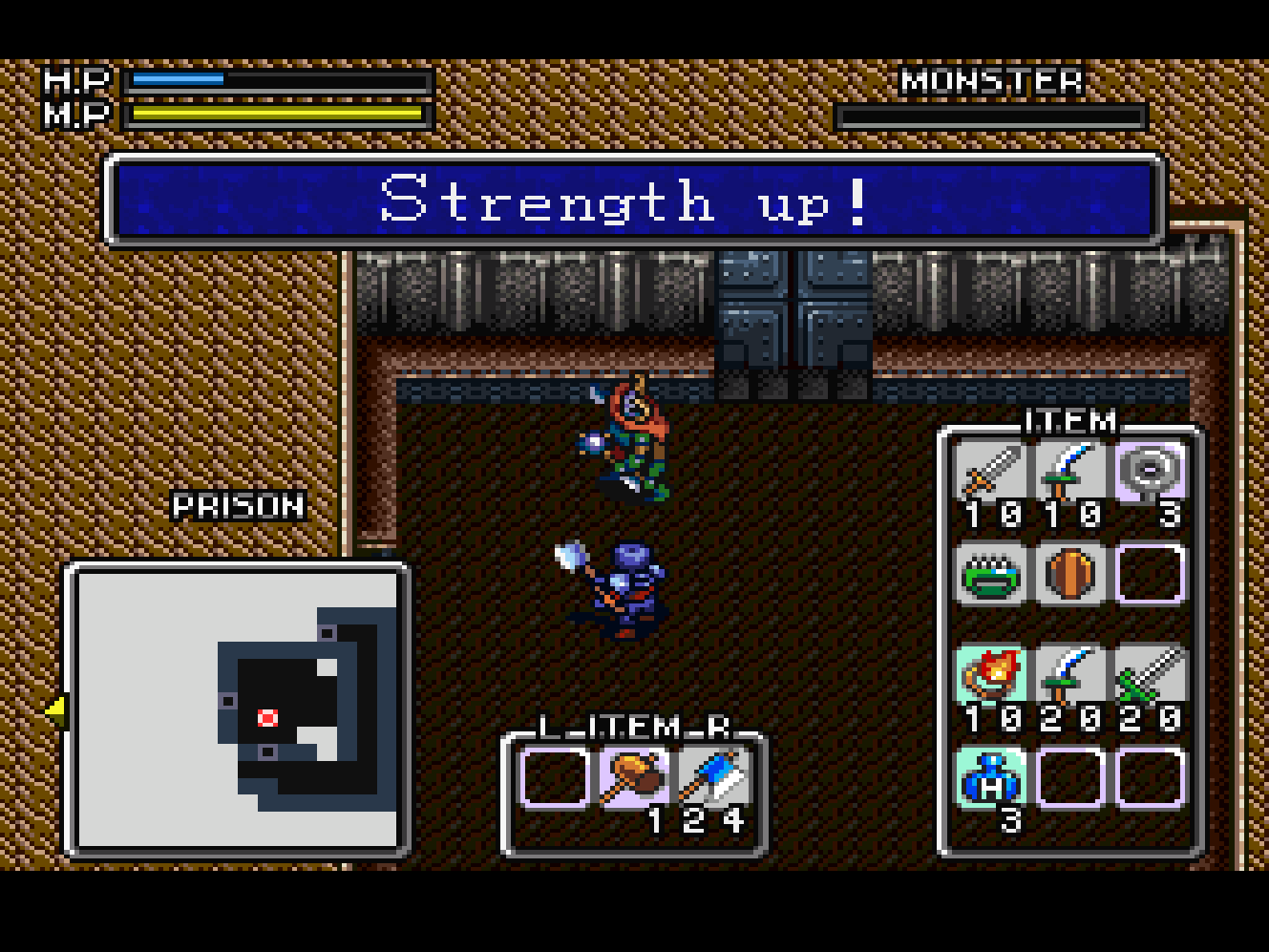
Brandish 2: The Planet Buster takes place shortly after the events of the first game. Ares gets lost in a desert and collapses. Luckily for him, he's found, resuscitated, and promptly imprisoned. Worse, the all-powerful & all-titular sword he was carrying with him was stolen. Escape the prison, storm the castle, delve into a world of darkness, climb the tower, explore the lab, and conquer the fortress. This adventure is liable to set you back 10 to 12 hours. Is it a worthwhile endeavor? Well...

...

Well...

...

Well...


Before going any further, I should make it clear that I played through the Super Famicom port, which was released by Koei in 1995. Fan-translations for both the SNES version and the PC-98 original exist and naturally I went with the inferior choice. Additionally, though the port does utilize the mouse, I chose to stick with the controller, which was another costly mistake. My experience is likely to be much different from yours, so keep that in mind if you're already well-familiar with the game or plan on playing it in the future. 

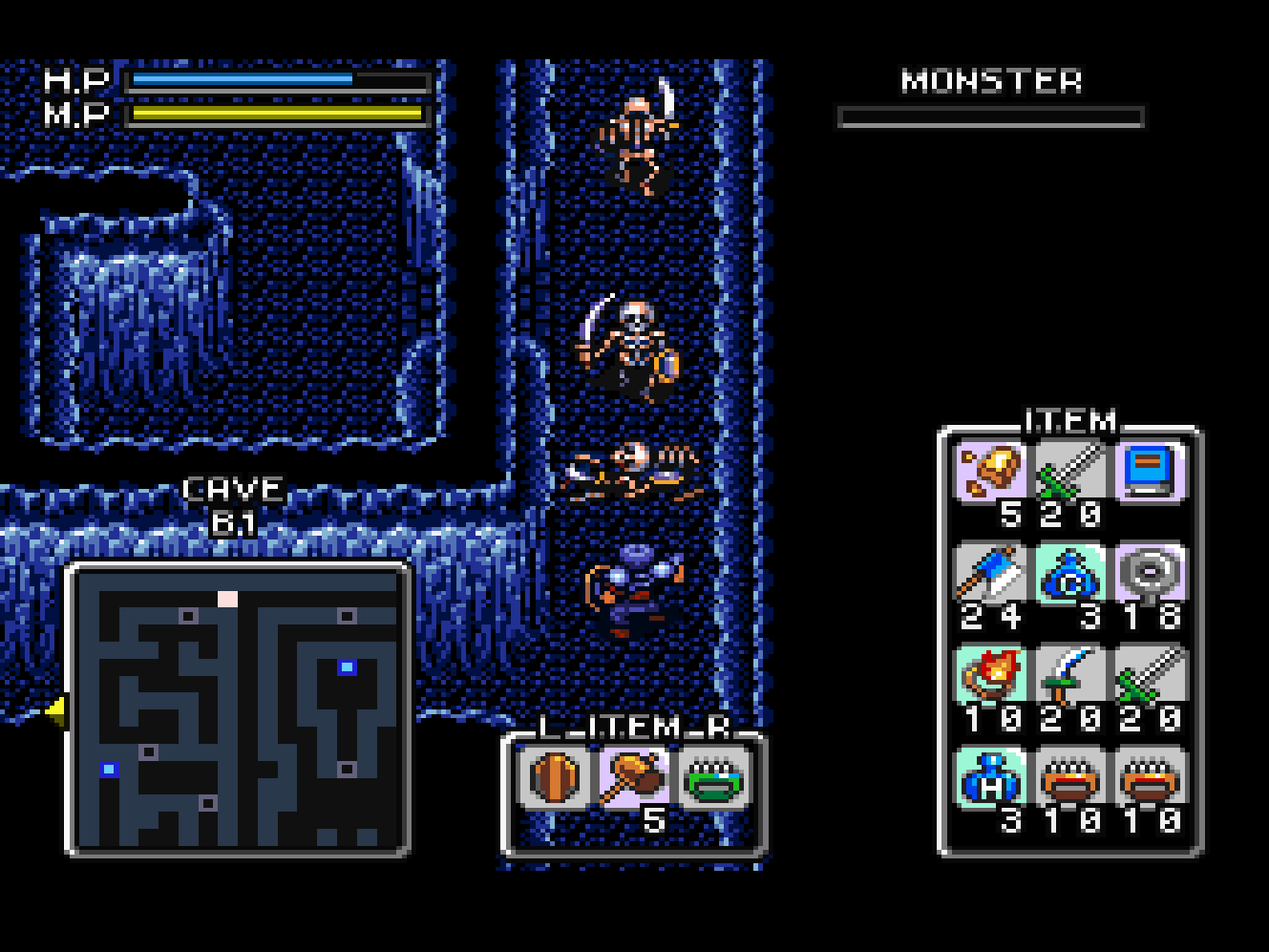
One of the most noticeable and notable qualities of this sequel is its variety in locales. Rather than a series of floors of ever-increasing complexity and difficulty, there are now dungeons both inside and outside to explore. Underground lairs are still quite common, but the forests and castle surroundings provide a hint of fresh air. The level-design still tends towards the maze-like, so don't expect to traipse through any large empty fields. Speaking of; the dungeons are at least as solid as the first entry, with some added variety and refinements. It's worth mentioning that there is nothing nearly as bad as that one floor in Brandish. You know the one where there are holes everywhere and Ares has to drop steel balls every step to avoid falling in them himself? Absolutely nothing like that is found here. The few dungeons that use pits often have multiple entrances, so you can fall multiple times and still accomplish objectives without starting from scratch.


Weapons are still as prone to breakage as ever. Though Ares can always resort to his fists, managing a limited supply of weaponry is still a big part of survival. There are more armaments to acquire, including fist-weapons and two-handed hammers & axes. Dual wielding is possible, but I never found a need or want for it in my play-through. Excess items and equipment are common, as-is the almost constant inventory fumbling. Items & Spells can be used from the menu and/or the quickslot. Ideally, players should make use of both functions, but that's pretty difficult with just a controller. As far as magic is concerned, your most-used spells are liable to be ice and the buffs. Ice can freeze most enemies, which has numerous benefits. The buffs are extremely strong. A buffed offense will crush most any fiend in a few hits while a buffed defense will turn otherwise devastating blows into a kitten's loving bites.

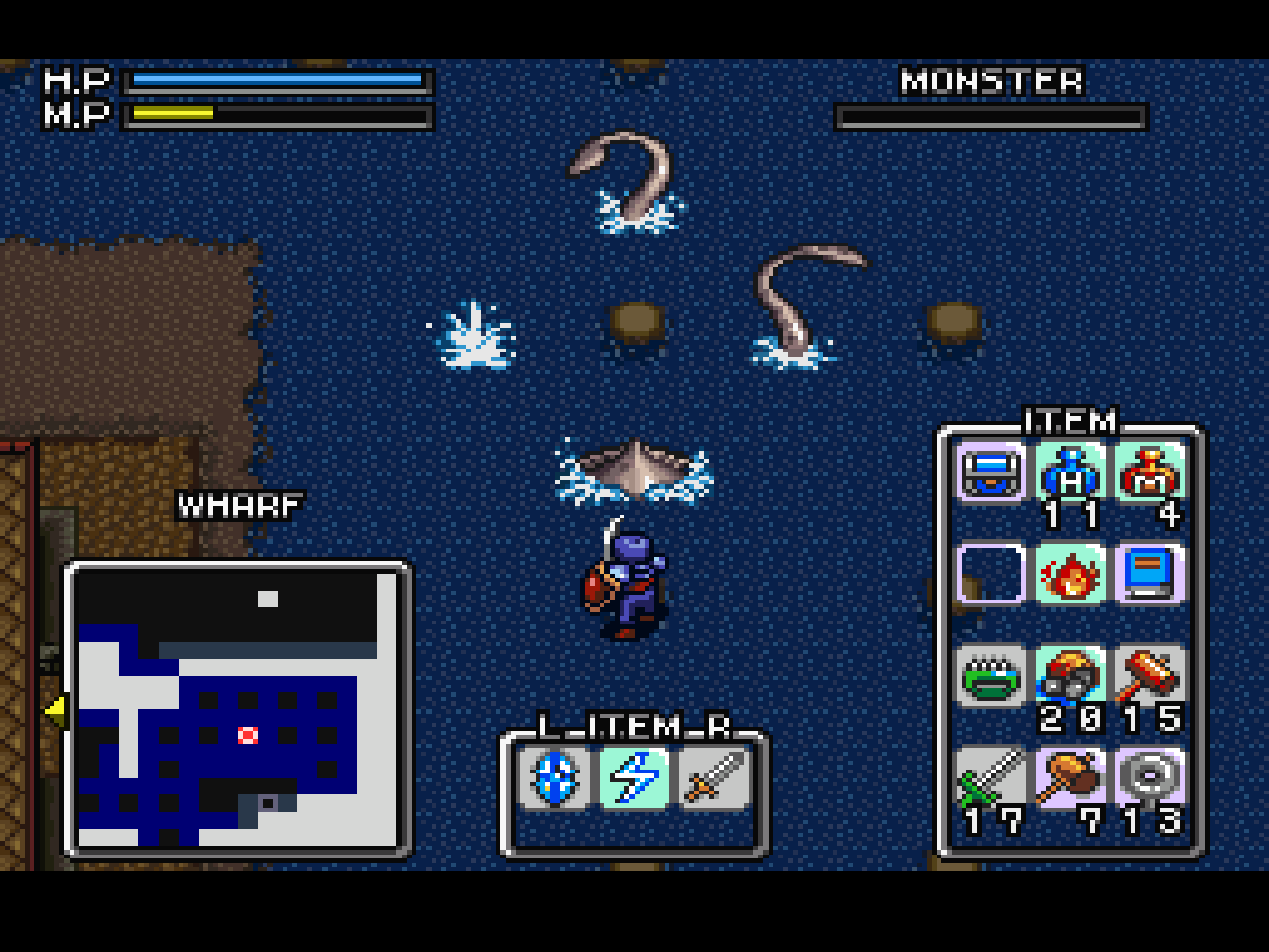
Much like the first game, bosses aren't always a "here's a large foe that hits really hard". Many require skillful maneuverings and smart tactics. The kraken will have Ares leaping from stone to stone, attempting to position himself in a prime spot to attack the beast's head while avoiding its poisonous smog. Defeating a master ninja requires constant movement and reorienting oneself, avoiding at all costs a frontal attack. When an attack is blocked, weapons lose 2 points of durability instead of just 1. Avoiding costly mistakes like these lends some flavor to numerous encounters. However, there are also times when an adversary just doesn't seem all that invested in attacking me, sometimes wandering in a random direction. Maybe it's by design, but it's still a little off-putting in the heat of battle.


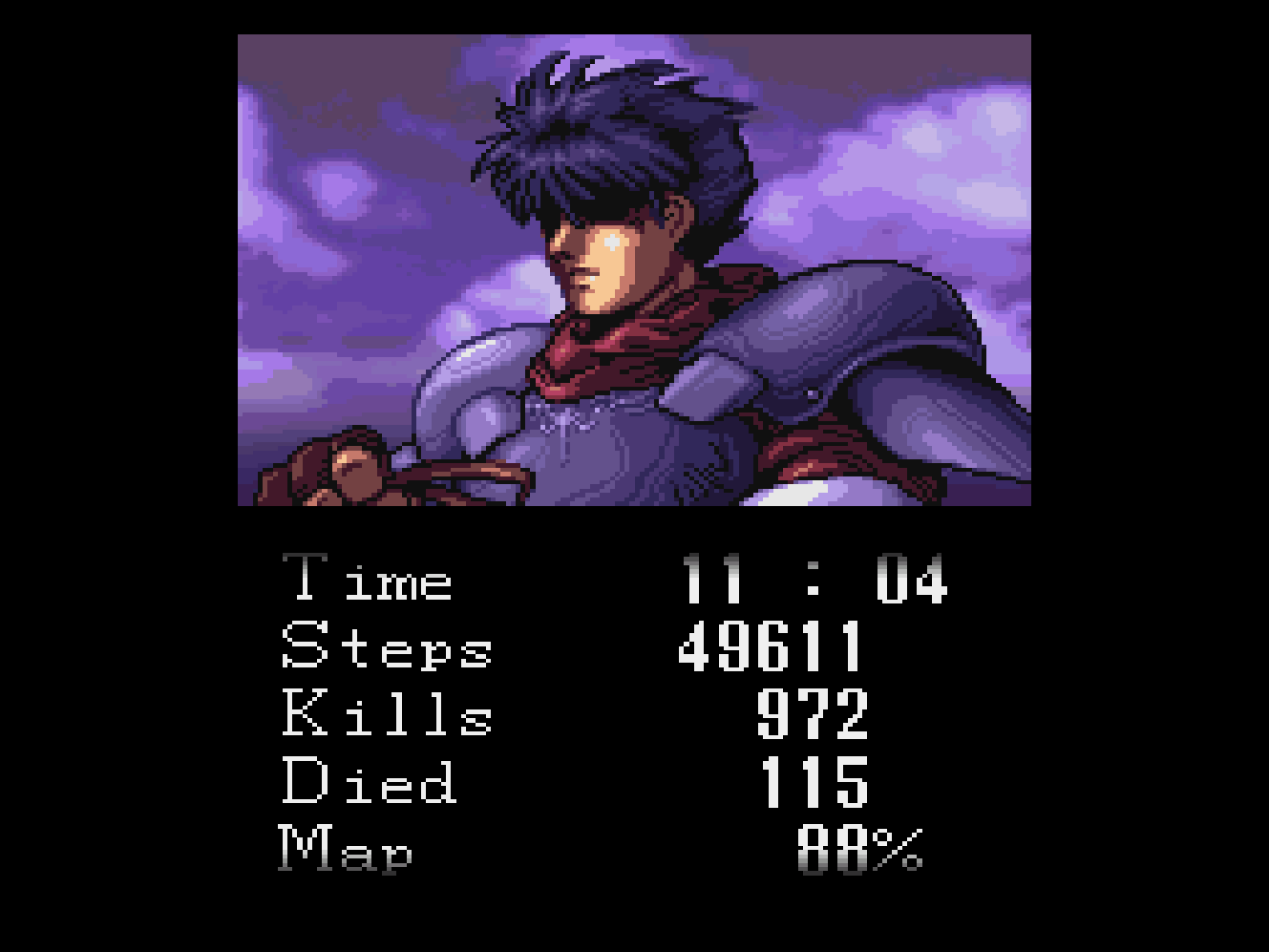
I mentioned the fluid difficulty of Brandish before, and that still applies here... mostly. Encounters are open-ended to the point that you can fight a tough monster, leave the room to rest, and that same monster will still be in the state you left them in when you return. To add to this, if you've got a good bit of distance away from the enemy, you can take a powernap to avoid dipping into your potion supply. Opportunities for staying healthy are extremely prevalent. In spite of this, I managed to die 115 times in an 11-hour play-through. 115! I'm sincerely positive that I died less in over a hundred hours of Elden Ring. What gives?

When seemingly every advantage is given to the player, the game leaves itself with no other recourse than what I call the nuclear option. In short, a lot of what Ares will run into in Brandish 2 will kill him in a couple of hits. I feel like there's some unexplained critical hit mechanic that allows enemies to 100% ignore armor to take huge chunks of life all at once. Whatever the case, mid to late-game encounters are usually determined by whether or not the player applied their buffs. There is still benefit and sometimes necessity to learning when to strike and when to move, but for the most part combat is a banal process. It's an awful shame, since I remember The Dark Revenant being so engaging in that regard. Learning that "dance of death" to get around enemies and strike them down was a lot of fun.


This issue is further compounded by both the controls and the lag. Whether it's moving, fighting, or managing, every action feels sluggish with the controller. Yes, yes, "use the mouse" should've been drilled into my head in the beginning. Still, I'd argue that even that wouldn't have been enough, because of the lag. It's hard to pinpoint, but it's there, like an ever-present haze. It's not so much slowdown as it is the occasional hiccup, and that hiccup is enough to eat an input. To put it another way, I attempt to strafe to the left to avoid an enemy, but the L button doesn't register, so that strafe becomes a turn and now I'm getting stabbed in the back. This lack of responsiveness has a chilling effect in that I'm less likely to take risks. This means more time spent saving in-between battles and employing safety strategies. I say all this, and yet I still have 115 deaths to my name. 

Needless to say, my initial enjoyment was eventually smothered, leaving me with a game that just didn't feel good to play. At some point I realized that even the shops have lag. Why am I losing inputs in the shop? There are just a couple of menus and a busty shopkeeper making kissy faces at Ares. That's enough to tax the Super Nintendo somehow. Seriously though, this was a regrettable adventure. 

Just skip straight to the PC-98 original. On the absurdly slim chance that the game is just inherently flawed, at least you're guaranteed a smoother experience.


Tuesday, May 13, 2025

2025 Special - Record of Lodoss War

Eons ago, I wrote a nothing-review for Record of Lodoss War. This Action-RPG for the Dreamcast deserves at least a semi-close look. It's a maniacal yet oddly satisfying grind. Crushing adversity under the sheer weight of huge numbers refuses to go out of style. Whatever sauce Neverland cooked up here was enough to pull me away from dozens of other games. Shoot. I've got a copy of Clair Obscur: Expedition 33 that still hasn't been unwrapped! Imagine, putting off one of the best games of the year just to follow the adventures of The World's Least Interesting Person.


See that rough fellow? That's going to be you for the 15 to 20 hours. Also, your name is Larx... or Larz, or something else, I forget exactly. Never mind, it's a useless detail. The important thing is that you're on a quest to rescue Marmo from the Evil Goddess Kardis. Also, you were brought back from the dead, but don't expect any cool undead powers. If you die again, it's back to loading that last save to try again. The bulk of your early game deaths are the result of going to the wrong place and getting immediately clobbered. Indeed, you can explore a large chunk of the world shortly after the introductory dungeon, just don't expect to get far. Marmo is packed with all manner of creeps, cluttering the largely mundane & dreary locales with monstrous visages and fireball-throwing mayhem. 

Early on, the best you can do is to simply follow the directions you're given. If Wart the wizard tells you to head north, then you should do so without giving a moment's thought to anything else. Larz is frail and a bit useless early on. However, given enough effort - and enough mythril - he'll become strong enough to take down a divine being singlehandedly. Actually, strike that. I meant to say, "a divine being, their closest allies, and a dozen friends singlehandedly". The odds are explicitly designed to be overwhelming, and that's fine. It just means more corpses underneath your boots... provided you get those numbers pumped up.


It won't take long to realize that levelling in Record of Lodoss War doesn't do a whole lot. An extra 20 HP and a +1 to attack isn't going to cut it. This is where the mythril comes in. Well, the game calls it "mithrill", but let's try and ignore that. Whether you're carving it out of monsters or off of the walls, this shiny blue ore is the currency that helps you become like a God. Early on, you'll meet a blacksmith who hammers rune words into your equipment. Explore the world to find rune words, then teleport back to base and spend the mythril on upgrades. I can't emphasize enough that this process is a massive grind, but the results are worth it. All those monsters you had to run past or away from will eventually be squashed like pitiful insects. The word eventually is doing some heavy lifting here. Some players could find themselves in a rut where they can't seem to make progress in either the story or the optional content. 

I'll admit, I took advantage of a couple exploits. There's an easy source of mythril involving a boss that can't seem to stay dead. Adversaries are generally decent at pathfinding, but it's still possible for them to get stuck on something. Consider it a perfect chance to spam walls of fire. Clever usage of a "raise the dead" spell could even the odds in a tough battle. Well, perhaps that isn't an exploit, but considering how much of the game is usually spent running up and smacking something with a sword... thinking is almost like cheating. Besides being few and far between, these moments that require strategizing will fall by the wayside once the protagonist's power level starts jumping exponentially. 

This big silver dude will keep respawning if you revisit his lair. Easy mythril.

Now rune words are usually basic upgrades like +3 Strength or whatever. Take the time to wipe out the optional lairs and you'll discover special rune words. Only one can be equipped at a time, but the right combination can turn Larz from zero to hero in a second. For example. I equipped a couple of special runes that caused my hit-points to reach an astonishing 15,000+. Another doubled my armor, so even bulky foes could only tickle me with their gigantic hammers. The grind gets intense, but the results are plain as day and very satisfying to achieve. Also, while some might view it as a negative, I really appreciate that mythril rarely drops from normal monsters. It incentivizes me to focus on the next objective and avoid unnecessary battles, particularly in the overworld. 

A philosophical question I've often run into with RPGs, whether they be action or turn-based, is what does the hero do with their unfathomable amounts of power? There are multiple points in this very game where power corrupts individuals until they become psychotic monsters hellbent on annihilating all life. I can't imagine even the most virtuous of heroes settling for field-tilling or sleeping on the couch after they had just toppled Gods. 


Though this game is 25 years old, I'm still putting up a SPOILER WARNING here and now.

Got it? 

...

Okay... let's get on with the spoiling.

Neverland answers this quandary in a manner that's blunt yet appreciable. The protagonist dies. Yeah, turns out that the whole "brought back from the dead" deal was only temporary. He stopped Kardis, completed his mission, and fell over dead after a second's worth of celebrating. Now, there is a post-game, but it's one of those post-games where you're probably better off just staying dead. The Cold Cave is a nightmare. No matter where you step, dozens of rapidly spawning monsters hound you. They might start off a bit weak, but their numbers never drop below overwhelming. The nastiest fiends become increasingly frequent with every step. It's important to note that being turned to stone is the #1 cause of death in the post-game. Given enough time, you can recover from this ailment, but the chances of being tag-teamed into oblivion by two Medusa are shockingly high. There are handful of super-bosses to pit your ungodly strength against as well. Basically, you can stick to the ending where Larz takes a well-deserved eternal rest or the extended ending where he struggles futilely through increasingly absurd situations (and dies anyway because LOL). 


Once you're eyebrows-deep in a realm of madness that only the gaming maniacs of the world can appreciate, the fact that this is a Record of Lodoss War game becomes increasingly irrelevant. Oh sure, Parm, Deedlit, and some of the other characters of the classic series, make an appearance. They'll even lend a hand for a dungeon or boss-battle. Their justifications for why they're at this otherwise abandoned island are well-reasoned. It's just... their contributions to both the story and gameplay eventually become so distant that I'd almost forgotten they were ever there to begin with. I suppose they can't get too attached to someone who is literally a dead man walking, so fair enough. 

While Neverland is perhaps best known for their Lufia games, I believe they had a clear understanding of what makes for compelling Action RPGs. Their Dreamcast effort is rough in a number of ways. The slowdown when facing a massive swath of foes is particularly outrageous. Still, there weren't any crashes in my 15+ hours of playtime. A few QOL features like equipment transformation & duplication ensure powerful gear is never lost. It's a good time and unbelievably addictive.


Thursday, May 1, 2025

2025 Special - Sword of Mana

Fair warning. There will be spoilers.

Thank the goddess! Unlike the last game I reviewed, Sword of Mana doesn't go by half-a-dozen different names. Well, unless you count its original Japanese title Shin'yaku: Seiken Densetsu aka A New Testament: The Legend of the Sacred Sword. Wow. That actually sounds much cooler than what we got here in the West. Anyway, this 2003 title for the Game Boy Advance is a significant remake. The plot is roughly the same, but every other aspect has been reimagined. There are now subsystems on top of subsystems, numerous side-quests, and a handful of secrets that practically require a guide to discover. It's a layered Action RPG, and perhaps not everyone's cup of tea. 


Allow me to just come right out and say that I actually think pretty highly of this game. What stuck out to me is its approach to character development. Sure, the plot is the same, but the way characters struggle with its many setbacks and tragic events creates a melodramatic tone that I find really enjoyable. Not too long ago, I kicked around an idea for an RPG story, one where despite the protagonist's best efforts, they'd lose their friends and loved ones. Not an uncommon idea, even the greatest heroes can't save everyone. My idea was a bit different though. These relationships weren't torn apart by death, but were victim to a lack of communication, a growing disinterest in each other, words or actions that at the time didn't seem like much, but created a divide that not even saving the world would repair. 

While Sword of Mana doesn't have friendships crumbling like so many card-houses, there were multiple times where I felt emptiness. A noble sacrifice goes underappreciated. A protagonist's virtues are tested. It hurts the most when a supposedly just cause ends with what could be considered petty revenge. This is one of the darkest E-rated games I've played. There is no more death than in Final Fantasy Adventure, but every loss hits much harder, almost to the point where it loops around and becomes hilarious. Consider the story of Amanda. Shortly before dying, she begs the male lead to use her blood to rescue everyone who was turned into birds by Devius. The player can opt not to do this, since returning to the castle where everyone is imprisoned is entirely optional. However, if they decide to change everyone back, they'll quickly discover that at least a few people preferred the bird life. Like I said, noble sacrifice goes underappreciated. 


The funny thing is, I can't blame anyone who wishes they could remain a bird. Saving the world doesn't guarantee everyone a happy ending. This game doesn't often dwell on it, but there several NPCs that can't be helped. Sure, you can slay a thousand beasts, but you can't cure sickness or aging, let alone bring anyone back from the dead. It's a melancholy adventure, where sometimes the best you can do is to simply acknowledge and move on. Still, that doesn't mean you should ignore everyone, especially if they ask you for help. There are a lot of side-quests to complete. Bear in mind that the significance of the rewards is liable to be lost on anyone who isn't questing a lot. In other words, expect to receive a lot of dudbear coins. Their usefulness isn't made apparent until you've collected a large number of them. The benefit of this is that if you choose to ignore the plights of others, it isn't detrimental to your chances of finishing the game. 

Much like Legend of Mana, this adventure offers an extremely fluid approach to difficulty. There are a lot of features to engage with. If you choose to avoid them and just rush through the plot, then that's perfectly valid. You'll struggle a bit more with enemies & bosses, but that's the extent of the consequences of speedrunning. Players who decide to grind level-ups and skill-levels will have an exponentially easier time. The same can be said if they learn the class-system to get the best possible stat-boosts. The same can also be said if they master crafting. Those who take the time to obtain the best gear, explore the world with the finest comb, and learn all those guide-necessitating subsystems, then the difficulty becomes nonexistent. The developer expected most players to only mildly experiment with everything available to them but left the door wide-open for the maniacs to crush the game into the tiniest fragments. Speaking as someone who barely scratched the surface, I still ended up with a lance that was slaying bosses in three to five hits. 


Perhaps breaking the combat system is the fastest way to make it tolerable. I'll admit, I wasn't too fond of it. Somehow fighting is less refined than previous entries like Trials of Mana. Regular attacks can only hit one enemy at a time, which is awfully odd for a 2003 release. Many foes are strong or weak against various types of damage. This means a lot of switching between weapons. The menu isn't as efficient as I would've liked. Some sort of quick-select would have been wonderful. Alas, the GBA control pad lacks the extra button necessary for such a feature. After a long enough time, I learned to run past enemies that were immune to physical attacks. Learning to use spells outside of puzzles often isn't worth the trouble. Heals and buffs are all you really need. Surprisingly, the one title that kept coming to mind was Vagrant Story. I mean, there's undoubtedly a lot less friction to deal with, but the basic aspects are familiar enough. Switching weapons to deal with different enemies, sitting still for extended periods of time to replenish MP. Shoot, there are even some minor jumping puzzles. No crate pushing though. That's a damn shame (I'm joking! Please don't remake this game to add crates!)

Did I mention that bosses were dying in three to five hits? Yeah, so I'm afraid there's not a lot to discuss there. I guess it's cool that not every fight is just some big slug bug thingamathing that just has to be stabbed repeatedly. There are often environmental hazards like a spinning floor or health-depleting lava. Enough for me to say "oh that's something" the moment before the boss itself is obliterated. Hey! That's another Vagrant Story commonality right there! I don't think I fought a single boss that had more than 750 HP. I figure this was all designed that even players who didn't choose optimal weapons or leveling strategies didn't fall victim to HP inflation, and that's fine. though now I'm left wondering if I could've had a more fulfilling experience if my lance wasn't so gosh darn strong. Oh well.

Shame there's not much that can be done to make your allies anything but useless. I don't want to dwell on this feature for too long, because picking on something this half-baked simply isn't fair. I'll consider it a nod to the original, where the AI partner just wandered every which way and maybe chucked a fireball towards a monster. Still, it couldn't hurt to upgrade your partner's armor, because seeing their ghost follow you around for extended periods of time might wear upon your soul.

Sword of Mana's early 2000s localization is one of the highlights. Everyone is a total corndog. The male lead is always yelling "Whoooooaaaaaaaa!" and at one point drops an honest-to-goodness "Say WHAT?" The female lead can also be endearingly dorky. Everybody else they run into is probably, eventually going to say something quirky. It never gets overwhelming or cringe*, and I think that's what kept me looking forward to whatever someone has to say. However, since the plot is relatively unchanged from a 1991 Game Boy release, there will be an excess of unnecessary words.

All in all, this game tries for the same uniqueness that made Legend of Mana so appealing. It doesn't quite capture its flavor and richness, but I admire the effort. The developers put a lot of love into this adventure. They made some bold decisions that I might've slammed other games for. Did you know that there are hidden geodes that are impossible to see but are required for a side-quest? I stumbled onto one by wandering into an inconspicuous corner. Chances of acquiring any of the others without a guide are less than 1%, but whatever. When I think "artistic expression in a video game", that's exactly what comes to mind. 


*I'm guessing people don't say cringe anymore.