
I have something of a history with Nihon Falcom's Brandish series, and by series, I mean one game. That game is of course, Brandish: The Dark Revenant. Released on the Playstation Portable in 2009 - and finally getting localized in 2015 - this is a remake of the first entry in the series. Full 3D, arranged soundtrack, various QOL features and extras, you know the drill. I'm a fan of that game, said as much in a review I wrote some couple of years later. From concept to execution, I enjoyed everything about it.
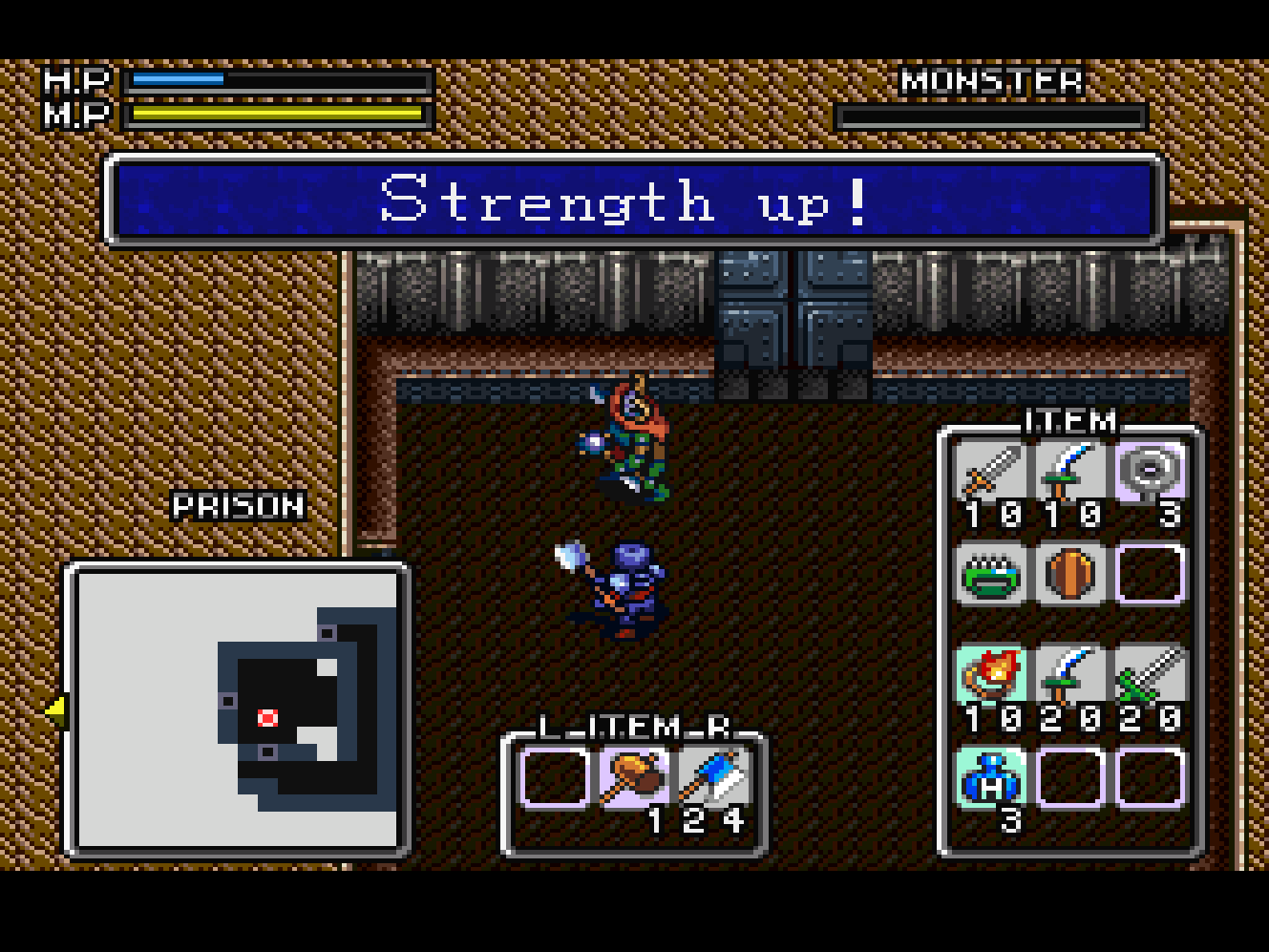
At its heart, Brandish is a real-time dungeon-crawler, but with an overhead perspective. A casual glance at a random screenshot might give off the impression that this a Zelda/Ys-inspired adventure, but the moment-to-moment gameplay has much more in common with something like Legend of Grimrock. When up is pressed on the d-pad, Ares moves forward. Pressing left or right turns Ares in the four cardinal directions. Holding down the L button will allow him to strafe. The sudden 90-degree turns are disorienting, and there's no telling if it'll take 5 minutes or 5 hours to adjust to them, but they work in establishing the game's unique approach.
Combat is typically of matter of maneuvering around enemies to strike at their weaker sides & rear. How you go about this is entirely up to your playstyle. In most cases, an ambush is preferable to a frontal assault. Attacking an enemy that's facing Ares provides them opportunities to block and counter-attack. The protagonist can also deflect blows, but not if they're haplessly swinging away. Timing as well as avoiding prolonged encounters are a couple necessities of survival, but this is very much a teaching game. You learn by doing (and dying). The level of difficulty is fluid in the sense that cautious players can stock up on curatives and save all the time, pros can eschew both for the added challenge, and maniacs can try to defeat every boss without getting hit. All of the above is possible, which is a testament to Falcom's immense gamedev talent.
Most anyone who has heard of Brandish has probably seen some artwork depicting an attractive blonde woman in a magic bikini and cape. That's Dela Delon (or Dora Doron) and she's the main character of the series. Granted, you don't play as her outside of Brandish 3 and a bonus mode in The Dark Revenant, but she gets most of the characterization and is present for almost every major story beat. Dela is a bit like a cross between Doronjo and Naga the Serpent. In short, she's the comic relief. Ares, the person you actually control, is the blankest of slates. He doesn't even have eyes! If he wasn't constantly stumbling into dungeons, he'd probably be the player-insert in some dating sim. His notable traits are... well... some of the shopkeepers say he has a nice bod. That's all I've got.
Brandish 2: The Planet Buster takes place shortly after the events of the first game. Ares gets lost in a desert and collapses. Luckily for him, he's found, resuscitated, and promptly imprisoned. Worse, the all-powerful & all-titular sword he was carrying with him was stolen. Escape the prison, storm the castle, delve into a world of darkness, climb the tower, explore the lab, and conquer the fortress. This adventure is liable to set you back 10 to 12 hours. Is it a worthwhile endeavor? Well...
...
Well...
...
Well...
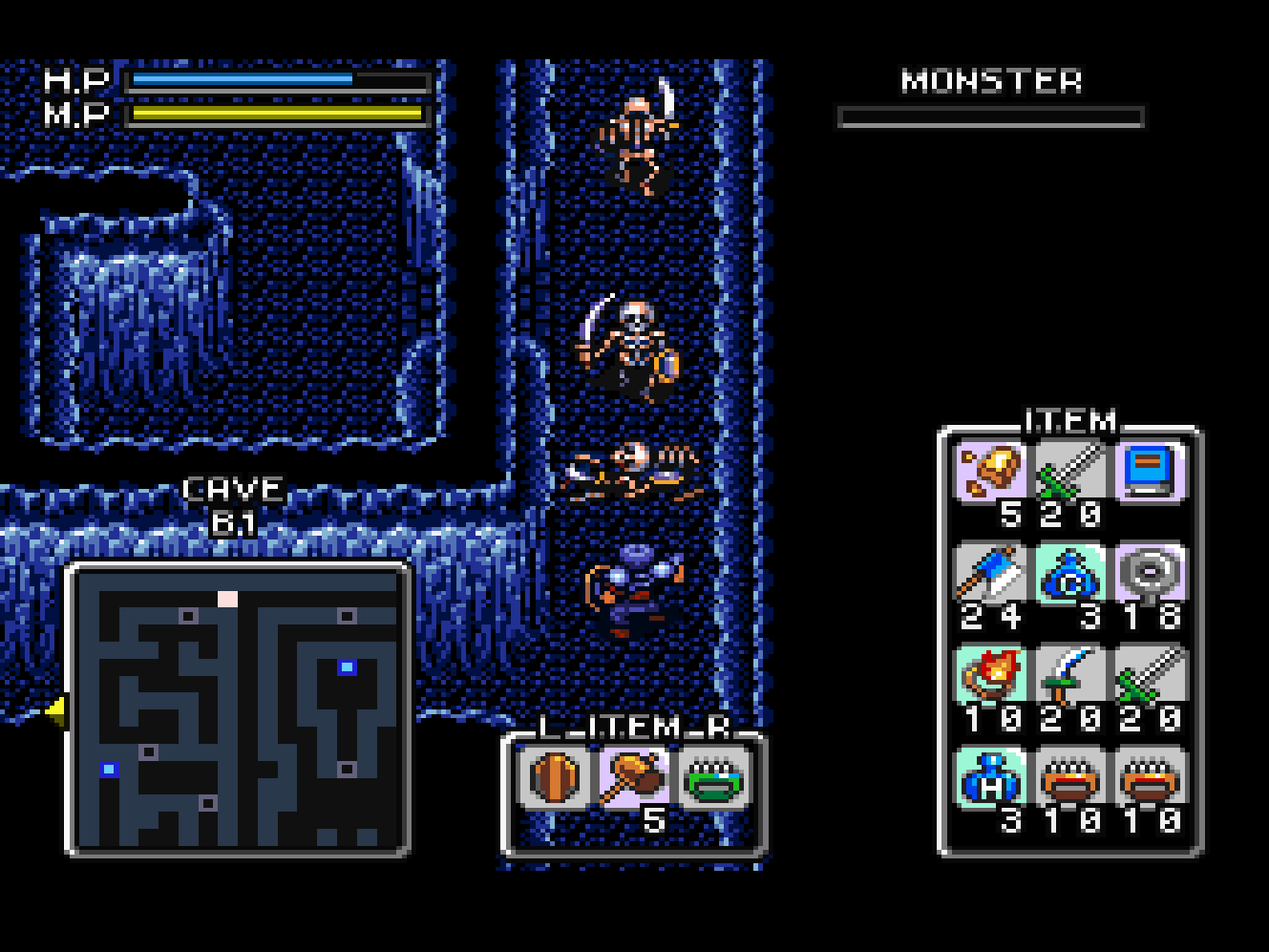
Before going any further, I should make it clear that I played through the Super Famicom port, which was released by Koei in 1995. Fan-translations for both the SNES version and the PC-98 original exist and naturally I went with the inferior choice. Additionally, though the port does utilize the mouse, I chose to stick with the controller, which was another costly mistake. My experience is likely to be much different from yours, so keep that in mind if you're already well-familiar with the game or plan on playing it in the future.
One of the most noticeable and notable qualities of this sequel is its variety in locales. Rather than a series of floors of ever-increasing complexity and difficulty, there are now dungeons both inside and outside to explore. Underground lairs are still quite common, but the forests and castle surroundings provide a hint of fresh air. The level-design still tends towards the maze-like, so don't expect to traipse through any large empty fields. Speaking of; the dungeons are at least as solid as the first entry, with some added variety and refinements. It's worth mentioning that there is nothing nearly as bad as that one floor in Brandish. You know the one where there are holes everywhere and Ares has to drop steel balls every step to avoid falling in them himself? Absolutely nothing like that is found here. The few dungeons that use pits often have multiple entrances, so you can fall multiple times and still accomplish objectives without starting from scratch.
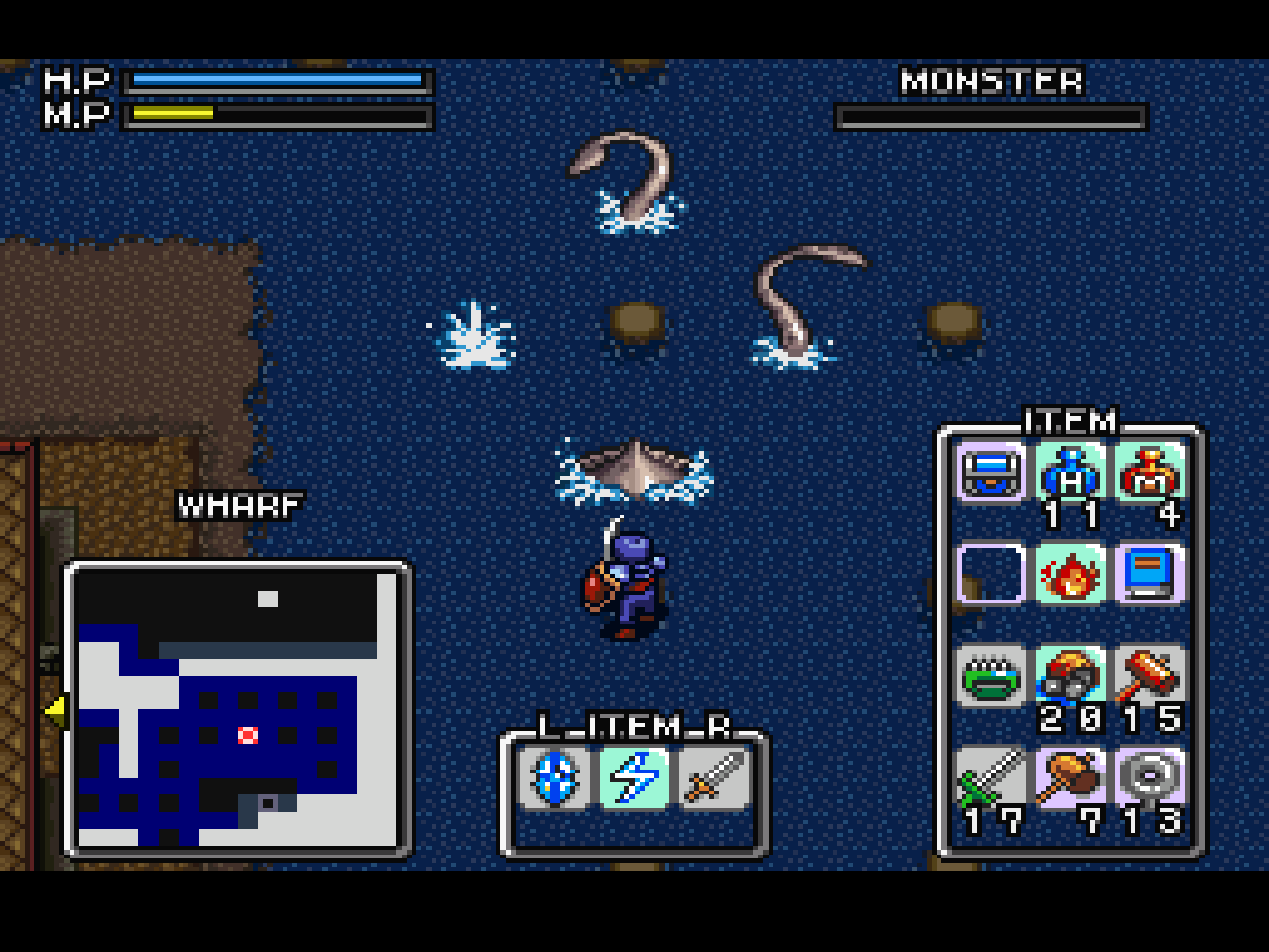
Weapons are still as prone to breakage as ever. Though Ares can always resort to his fists, managing a limited supply of weaponry is still a big part of survival. There are more armaments to acquire, including fist-weapons and two-handed hammers & axes. Dual wielding is possible, but I never found a need or want for it in my play-through. Excess items and equipment are common, as-is the almost constant inventory fumbling. Items & Spells can be used from the menu and/or the quickslot. Ideally, players should make use of both functions, but that's pretty difficult with just a controller. As far as magic is concerned, your most-used spells are liable to be ice and the buffs. Ice can freeze most enemies, which has numerous benefits. The buffs are extremely strong. A buffed offense will crush most any fiend in a few hits while a buffed defense will turn otherwise devastating blows into a kitten's loving bites.
Much like the first game, bosses aren't always a "here's a large foe that hits really hard". Many require skillful maneuverings and smart tactics. The kraken will have Ares leaping from stone to stone, attempting to position himself in a prime spot to attack the beast's head while avoiding its poisonous smog. Defeating a master ninja requires constant movement and reorienting oneself, avoiding at all costs a frontal attack. When an attack is blocked, weapons lose 2 points of durability instead of just 1. Avoiding costly mistakes like these lends some flavor to numerous encounters. However, there are also times when an adversary just doesn't seem all that invested in attacking me, sometimes wandering in a random direction. Maybe it's by design, but it's still a little off-putting in the heat of battle.

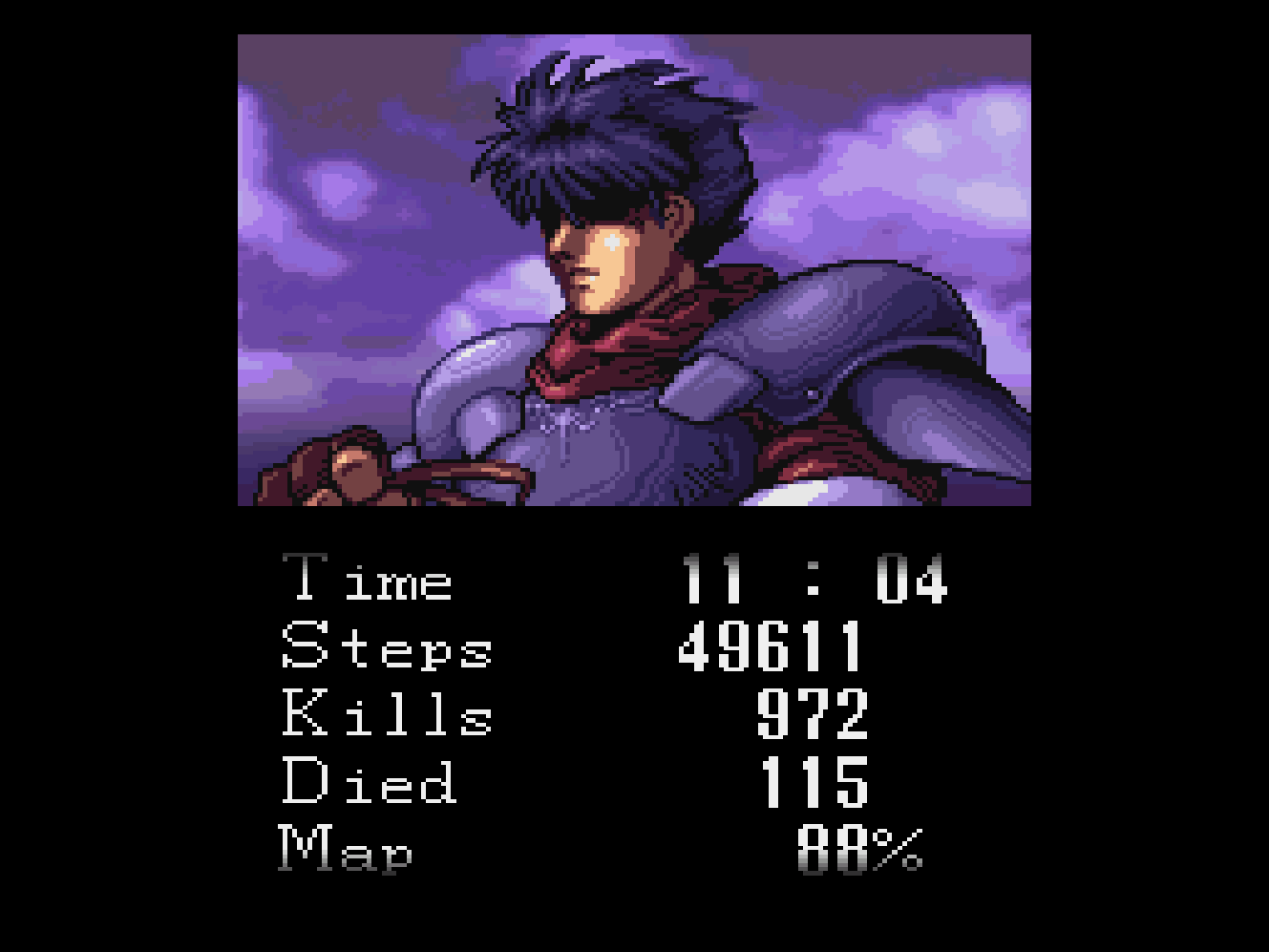
I mentioned the fluid difficulty of Brandish before, and that still applies here... mostly. Encounters are open-ended to the point that you can fight a tough monster, leave the room to rest, and that same monster will still be in the state you left them in when you return. To add to this, if you've got a good bit of distance away from the enemy, you can take a powernap to avoid dipping into your potion supply. Opportunities for staying healthy are extremely prevalent. In spite of this, I managed to die 115 times in an 11-hour play-through. 115! I'm sincerely positive that I died less in over a hundred hours of Elden Ring. What gives?
When seemingly every advantage is given to the player, the game leaves itself with no other recourse than what I call the nuclear option. In short, a lot of what Ares will run into in Brandish 2 will kill him in a couple of hits. I feel like there's some unexplained critical hit mechanic that allows enemies to 100% ignore armor to take huge chunks of life all at once. Whatever the case, mid to late-game encounters are usually determined by whether or not the player applied their buffs. There is still benefit and sometimes necessity to learning when to strike and when to move, but for the most part combat is a banal process. It's an awful shame, since I remember The Dark Revenant being so engaging in that regard. Learning that "dance of death" to get around enemies and strike them down was a lot of fun.

This issue is further compounded by both the controls and the lag. Whether it's moving, fighting, or managing, every action feels sluggish with the controller. Yes, yes, "use the mouse" should've been drilled into my head in the beginning. Still, I'd argue that even that wouldn't have been enough, because of the lag. It's hard to pinpoint, but it's there, like an ever-present haze. It's not so much slowdown as it is the occasional hiccup, and that hiccup is enough to eat an input. To put it another way, I attempt to strafe to the left to avoid an enemy, but the L button doesn't register, so that strafe becomes a turn and now I'm getting stabbed in the back. This lack of responsiveness has a chilling effect in that I'm less likely to take risks. This means more time spent saving in-between battles and employing safety strategies. I say all this, and yet I still have 115 deaths to my name.
Needless to say, my initial enjoyment was eventually smothered, leaving me with a game that just didn't feel good to play. At some point I realized that even the shops have lag. Why am I losing inputs in the shop? There are just a couple of menus and a busty shopkeeper making kissy faces at Ares. That's enough to tax the Super Nintendo somehow. Seriously though, this was a regrettable adventure.
Just skip straight to the PC-98 original. On the absurdly slim chance that the game is just inherently flawed, at least you're guaranteed a smoother experience.


No comments:
Post a Comment