Fair warning. There will be spoilers.
Thank the goddess! Unlike the last game I reviewed, Sword of Mana doesn't go by half-a-dozen different names. Well, unless you count its original Japanese title Shin'yaku: Seiken Densetsu aka A New Testament: The Legend of the Sacred Sword. Wow. That actually sounds much cooler than what we got here in the West. Anyway, this 2003 title for the Game Boy Advance is a significant remake. The plot is roughly the same, but every other aspect has been reimagined. There are now subsystems on top of subsystems, numerous side-quests, and a handful of secrets that practically require a guide to discover. It's a layered Action RPG, and perhaps not everyone's cup of tea.
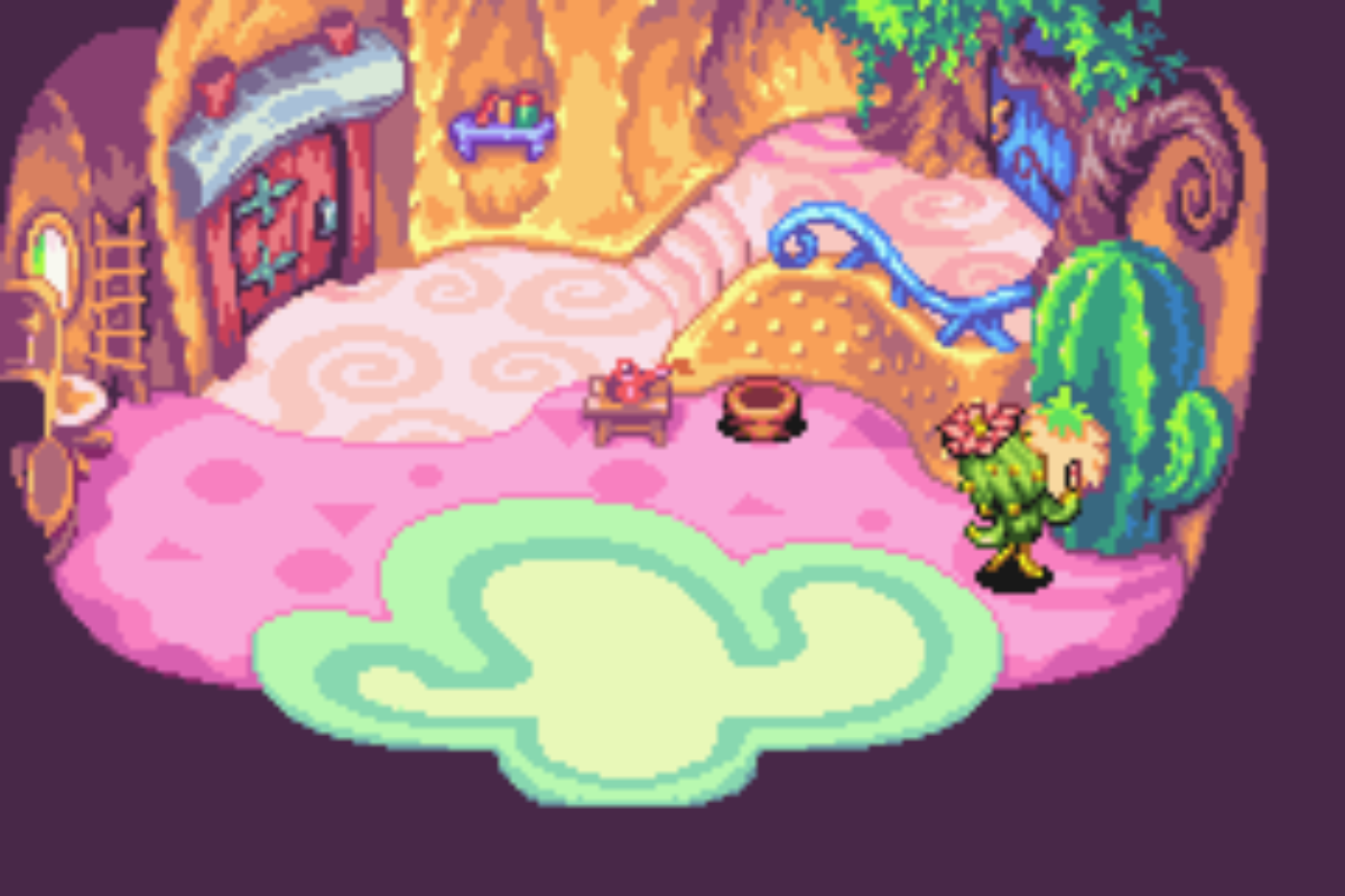
Allow me to just come right out and say that I actually think pretty highly of this game. What stuck out to me is its approach to character development. Sure, the plot is the same, but the way characters struggle with its many setbacks and tragic events creates a melodramatic tone that I find really enjoyable. Not too long ago, I kicked around an idea for an RPG story, one where despite the protagonist's best efforts, they'd lose their friends and loved ones. Not an uncommon idea, even the greatest heroes can't save everyone. My idea was a bit different though. These relationships weren't torn apart by death, but were victim to a lack of communication, a growing disinterest in each other, words or actions that at the time didn't seem like much, but created a divide that not even saving the world would repair.
While Sword of Mana doesn't have friendships crumbling like so many card-houses, there were multiple times where I felt emptiness. A noble sacrifice goes underappreciated. A protagonist's virtues are tested. It hurts the most when a supposedly just cause ends with what could be considered petty revenge. This is one of the darkest E-rated games I've played. There is no more death than in Final Fantasy Adventure, but every loss hits much harder, almost to the point where it loops around and becomes hilarious. Consider the story of Amanda. Shortly before dying, she begs the male lead to use her blood to rescue everyone who was turned into birds by Devius. The player can opt not to do this, since returning to the castle where everyone is imprisoned is entirely optional. However, if they decide to change everyone back, they'll quickly discover that at least a few people preferred the bird life. Like I said, noble sacrifice goes underappreciated.

The funny thing is, I can't blame anyone who wishes they could remain a bird. Saving the world doesn't guarantee everyone a happy ending. This game doesn't often dwell on it, but there several NPCs that can't be helped. Sure, you can slay a thousand beasts, but you can't cure sickness or aging, let alone bring anyone back from the dead. It's a melancholy adventure, where sometimes the best you can do is to simply acknowledge and move on. Still, that doesn't mean you should ignore everyone, especially if they ask you for help. There are a lot of side-quests to complete. Bear in mind that the significance of the rewards is liable to be lost on anyone who isn't questing a lot. In other words, expect to receive a lot of dudbear coins. Their usefulness isn't made apparent until you've collected a large number of them. The benefit of this is that if you choose to ignore the plights of others, it isn't detrimental to your chances of finishing the game.
Much like Legend of Mana, this adventure offers an extremely fluid approach to difficulty. There are a lot of features to engage with. If you choose to avoid them and just rush through the plot, then that's perfectly valid. You'll struggle a bit more with enemies & bosses, but that's the extent of the consequences of speedrunning. Players who decide to grind level-ups and skill-levels will have an exponentially easier time. The same can be said if they learn the class-system to get the best possible stat-boosts. The same can also be said if they master crafting. Those who take the time to obtain the best gear, explore the world with the finest comb, and learn all those guide-necessitating subsystems, then the difficulty becomes nonexistent. The developer expected most players to only mildly experiment with everything available to them but left the door wide-open for the maniacs to crush the game into the tiniest fragments. Speaking as someone who barely scratched the surface, I still ended up with a lance that was slaying bosses in three to five hits.

Perhaps breaking the combat system is the fastest way to make it tolerable. I'll admit, I wasn't too fond of it. Somehow fighting is less refined than previous entries like Trials of Mana. Regular attacks can only hit one enemy at a time, which is awfully odd for a 2003 release. Many foes are strong or weak against various types of damage. This means a lot of switching between weapons. The menu isn't as efficient as I would've liked. Some sort of quick-select would have been wonderful. Alas, the GBA control pad lacks the extra button necessary for such a feature. After a long enough time, I learned to run past enemies that were immune to physical attacks. Learning to use spells outside of puzzles often isn't worth the trouble. Heals and buffs are all you really need. Surprisingly, the one title that kept coming to mind was Vagrant Story. I mean, there's undoubtedly a lot less friction to deal with, but the basic aspects are familiar enough. Switching weapons to deal with different enemies, sitting still for extended periods of time to replenish MP. Shoot, there are even some minor jumping puzzles. No crate pushing though. That's a damn shame (I'm joking! Please don't remake this game to add crates!)
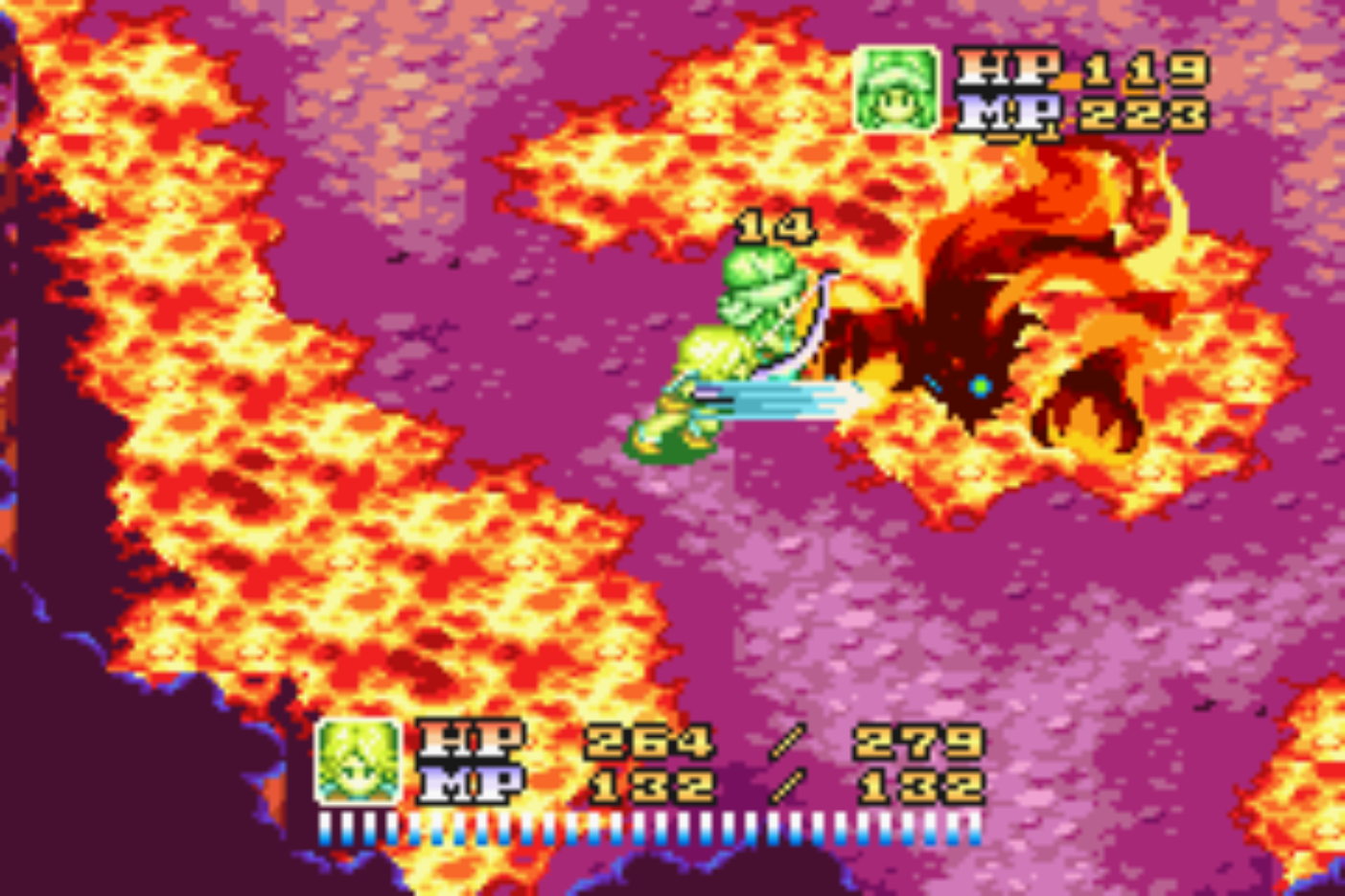
Did I mention that bosses were dying in three to five hits? Yeah, so I'm afraid there's not a lot to discuss there. I guess it's cool that not every fight is just some big slug bug thingamathing that just has to be stabbed repeatedly. There are often environmental hazards like a spinning floor or health-depleting lava. Enough for me to say "oh that's something" the moment before the boss itself is obliterated. Hey! That's another Vagrant Story commonality right there! I don't think I fought a single boss that had more than 750 HP. I figure this was all designed that even players who didn't choose optimal weapons or leveling strategies didn't fall victim to HP inflation, and that's fine. though now I'm left wondering if I could've had a more fulfilling experience if my lance wasn't so gosh darn strong. Oh well.
Shame there's not much that can be done to make your allies anything but useless. I don't want to dwell on this feature for too long, because picking on something this half-baked simply isn't fair. I'll consider it a nod to the original, where the AI partner just wandered every which way and maybe chucked a fireball towards a monster. Still, it couldn't hurt to upgrade your partner's armor, because seeing their ghost follow you around for extended periods of time might wear upon your soul.
Sword of Mana's early 2000s localization is one of the highlights. Everyone is a total corndog. The male lead is always yelling "Whoooooaaaaaaaa!" and at one point drops an honest-to-goodness "Say WHAT?" The female lead can also be endearingly dorky. Everybody else they run into is probably, eventually going to say something quirky. It never gets overwhelming or cringe*, and I think that's what kept me looking forward to whatever someone has to say. However, since the plot is relatively unchanged from a 1991 Game Boy release, there will be an excess of unnecessary words.All in all, this game tries for the same uniqueness that made Legend of Mana so appealing. It doesn't quite capture its flavor and richness, but I admire the effort. The developers put a lot of love into this adventure. They made some bold decisions that I might've slammed other games for. Did you know that there are hidden geodes that are impossible to see but are required for a side-quest? I stumbled onto one by wandering into an inconspicuous corner. Chances of acquiring any of the others without a guide are less than 1%, but whatever. When I think "artistic expression in a video game", that's exactly what comes to mind.

*I'm guessing people don't say cringe anymore.


No comments:
Post a Comment