Saturday, April 26, 2025

2025 Special - Final Fantasy Adventure

Seiken Densetsu: Final Fantasy Gaiden is about what you'd expect given the title. It's the humble beginnings of a franchise that would develop its world and characters over several installments. What started as essentially a spin-off of Square's most popular brand would eventually become a brand all its own, the Brand... of Mana. I've been a Secret of Mana fan since forever ago, so it was a real treat seeing all of the little references that would be expanded upon in future installments. Not to mention, there are a ton of enemies & bosses in Adventures of Mana that would be revisited in glorious 256 x 224 Super Nintendo resolution. If all these names weren't confusing enough, an entry titled Sword of Mana was released on the Game Boy Advance. From the jump, it's a modernized - by 2003 standards - take on the Game Boy original. I'm sure I'll get to it someday.

Didn't I fight this guy in the beginning of Secret of Mana?

For now, let's try to get on track for what is a surprisingly solid take on the Zelda formula. The hero, who like always, goes by the name of Larx, escapes the carnage of the arena but takes a nasty tumble down a waterfall. With sword in hand and courage in heart, he must take on scores of fell beasts, explore a multitude of dungeons, while utilizing both weapons and spells to solve puzzles. It's a remarkable adventure that doesn't wear out its welcome. The pacing is smooth and efficient, with a consistent rate of new areas and monsters to overcome. In fact, I'm pretty sure there isn't any backtracking. The game has aged a fair bit though. Not excessively, but noticeably. 

Noticeably aging isn't the worst thing to happen to a video game, but it can affect the player's enjoyment. The combat is fine. Not as refined as it could be, but serviceable 98% of the time. In those rare cases where it felt like your weapon didn't connect when you felt that it should, the consequences of that are nonexistent. More to the point, unless you're trying to speedrun, you'll never once face the possibility of death. The protagonist starts off meager, but upon level up, you can decide to push the bulk of your stat-gains into stamina. Before long, your hero becomes a brick shithouse, a shitting bricks house, a brick that shits houses, whatever. Point is, unless you do something wild like get turned into a moogle or run into lava repeatedly, Larx's HP will never reach a critical point. Healing spells are cheap, you can save anywhere, there's nothing to worry about on that front.

You'll obtain weapons for breaking rocks, cutting down trees, and crossing gaps.

The dungeons are the one aspect that has aged the most. The overworld is mostly linear, so you'll rarely struggle with the point A to point B navigating. The dungeons are a bit more complicated, and not in the fun way. First off, you'll want to stock up on mattocks & keys. You don't want to end up in a situation where you run out of either. The game tries to throw you a bone by having certain monsters drop these necessary items, but you might end up having to leave to restock. The problems here are twofold. Leaving a dungeon resets the in-game map. Worse, leaving the room resets any unlocked doors or holes you've bashed in the walls. I hate to make direct comparisons, but when you unlock a door or blow up a wall in The Legend of Zelda, it stays that way forever. The same convenience couldn't be extended to Final Fantasy Adventure. A shame, but I suppose that's just the nature of game development. Again, if you've got enough stock, then it's not too big an issue. 

Knowing which walls are of the breakable kind is another story I'm afraid. To its credit, the game provides subtle hints for most of them... most of them. Checking the map can also help, though most dungeons are typically too straightforward for players to develop suspicions that something is being hidden from them. Necessary traversal weapons are acquired between dungeons, so the only real incentive to explore is for the very slight possibility of a hidden piece of equipment. I'm fairly sure that these specials occasions happen less than five times throughout an entire play-through. A few end-game enemies drop rare armor, and that's rad. Altogether though, you're probably better off keeping a guide within arm's reach just so you don't find yourself running in circles. 
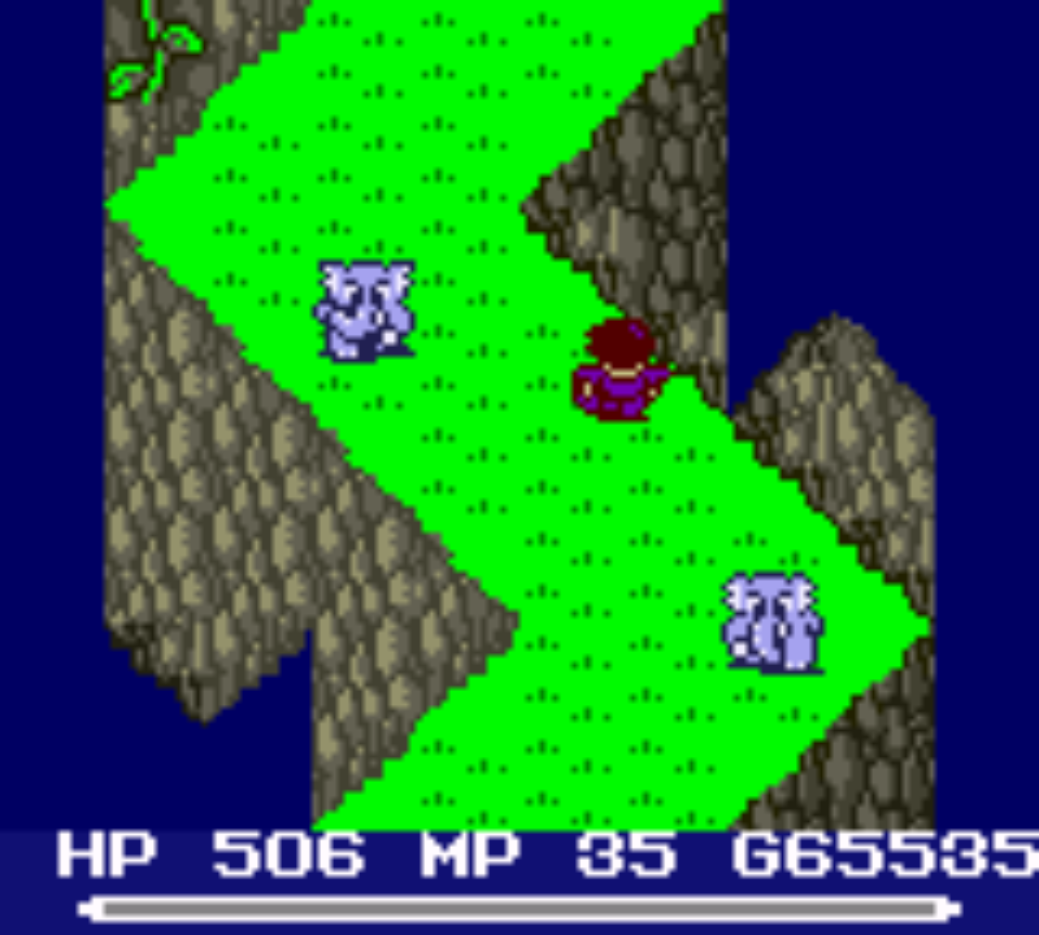

Still, aside from a couple potentially annoying instances, this is exactly the sort of breezy adventure you want after a stressful workday. Dealing with adversaries is no sweat, though they can cause any number of status effects. I mentioned that there's no threat of death and that remains the case, but there's fun in trying to avoid getting poisoned, moogled, turned to stone, etc. The near-constant supply of level-ups and armament upgrades are more than enough for your daily dopamine intake. Also, I can't think of anyone who'd turn down save-anywhere functionality.

It's a fine weekend game. All I need to say, really.

Before I forget, the reason the game looks so colorful here is because this is the Final Fantasy Adventure DX romhack. There's another hack called Legend of the Mana Sword that looks really good. Maybe one day I'll give that one a try.


Sunday, April 20, 2025

2025 Special - The Legend of Zelda: Link's Awakening DX

The Legend of Zelda: Link's Awakening is one of those games that is known and beloved by practically everyone. It's also significantly more difficult to write about than almost every other action-adventure I've covered in the past couple of months. Everything that can be said has already been said... or something. I forget how that cliched line is supposed to go. Point is, I've got the ugly task of coming up with a worthwhile thought for a game you already know everything about. 


Before going any further, it must be mentioned that this is the first time I've played through the game in over thirty years. I used to own the original version of Link's Awakening. The actual cartridge, if you can believe it. A lot of hours and batteries were spent on Koholint Island. 

A clearly tired Gabriel who spent all night and all morning playing Vampire Survivors has just sat in front of the keyboard.

Okay no, this isn't working.
I mean damn. What was I doing waxing nostalgia just a second ago? Gross! C'mon Mr. Jones, get it together! This isn't some untarnished symbol of hope. It's not a faint reminder of better days. It's a video game, so treat it like one. Let's get down to brass tacks, or rather... brass swords. Yeah, I haven't talked all that much about the swordplay in these Game Boy entries, and that's probably because it's perfectly functional. Perfectly functional, and maybe a little bland. What I'm saying here is that there's not enough spice in the sauce. Link's sword has this huge area of effect that instantly shreds any opposition. It's not 3D Dot Heroes' ridiculously thick sword swings, but it's still quite a lot. Like, I can't help but think about the original Legend of Zelda, back when Link's hit & run tactics were the only thing keeping him out of the grave. There were limits to his abilities, particularly his little stibbety-stab sword. A small sword trapped in a room with so many nasty monsters, that is one spicy recipe. Maybe the monsters of Koholint could've tried a little harder.

See what I mean? Everyone's a quitter.

All told, the swordplay is not a subject that I want to dwell on for too much longer. The combat is fine, serviceable, does what it needs to do. I wish it did a little bit more, but that's partly on me for revisiting the game after 30+ years and fresh memories of its successors. The Oracle duology, might I add, came out in 2001, nearly 8 years after Link's Awakening. That's a lot of time for analysis and player feedback. Still, I wouldn't be able to forgive myself if I didn't mention the reverse-difficulty issue. One of the hardest bosses is the clown genie from Bottle Grotto. It was in his second phase that I noticed the fireballs he was chucking around liberally swallowed hearts like donut holes. I set myself up thinking there'd be more adversaries like him, but nope. Bottle Grotto was also a lot shorter than I remember. Over time, the dungeons become larger and more complex, but the threat of death slinks further and further into the background until it almost disappears entirely. Almost, because the last phase of the final boss hits hard. It's especially painful if Link didn't bother to grab the blue tunic from the DX-exclusive dungeon.

Much like the simplistic swordplay, I can't complain overmuch about the reverse-difficulty. This is such an intricately-crafted game that its few issues never affected my enjoyment. Koholint Island. Hot damn. This might be one of the best overworlds I've ever explored. It's not densely packed with a gazillion secrets and things to interact with. It actually feels real, well... as real as a dream world in a video game, but whatever. Just the fact that I can come back to Koholint after 30+ years and still navigate it as easily as my own living room is unreal. 

Side note: I have got to stop saying "30+ years". Every utterance is causing me to age like that one asshole from The Last Crusade who drank out of the wrong cup. I'll be dust in the corner by the time 2025 finally ends.


Seriously though, this is one top tier overworld. One of its underrated qualities is that most of it can be explored with just a couple items: the feather & the bracelet. Link can visit several points of interest after clearing a mere two dungeons. He doesn't have to constantly swap items to get around either. The amount of time spent in the inventory screen is comparable to the NES game, which all things considered is pretty amazing. The Oracle entries deserve a ton of praise, but retrofitting an N64 Zelda's worth of items onto a two-button platform got to be really burdensome. Not only are there just enough items to make the adventure fulfilling, but players aren't obligated to swap their entire loadout every other screen. I love this amount of restraint. Nintendo has always had a keen understanding of game-design, and Link's Awakening is absolutely a showcase.

The dungeons themselves are also really good. Indeed, they are shorter than I remember, but let's be real here: I've got these two elephants sitting on my shoulders and I can't keep mentioning them. Besides, what's important here is the pacing. Each labyrinth is designed to be just long enough to warrant the player's full attention. Puzzles are often easy to understand and take very little time to solve. It just makes sense for a battery-powered platform aimed predominantly at kids to feature dungeons that can be completed in a brisk 10 to 20 minutes apiece. Eagle Tower, the 7th dungeon, features probably the most complicated puzzle in the entire game, which involves carrying an iron ball through several rooms to destroy four pillars. I actually got stuck here for a hot minute, and that's probably because I was going around it the wrong way. I mean that literally; I was trying to throw the iron ball across a chasm that's much too large. The game even casually drops a "if this isn't working then try a different approach" hint. Awfully kind of them. It's like they've noticed all the brainrot I've accumulated from playing forty action-adventures in four months.

Smashing the pillars is pretty satisfying.

Time spent in-between dungeons never feels wasted either. There is usually a small task that Link has to complete before he can proceed to the next dungeon, and I'm pretty sure I enjoyed all of them. They're an excuse to see the world, return to previously visited locations, and utilize acquired tools to find new paths or hidden rewards. Again, this is smart design. The subtlety is what brings everything together. I'm not just going from point A to point B so an NPC can hand me a key-item. I'm making my way around Koholint in ways that feel natural, as if I'm just as much an inhabitant as anyone else.

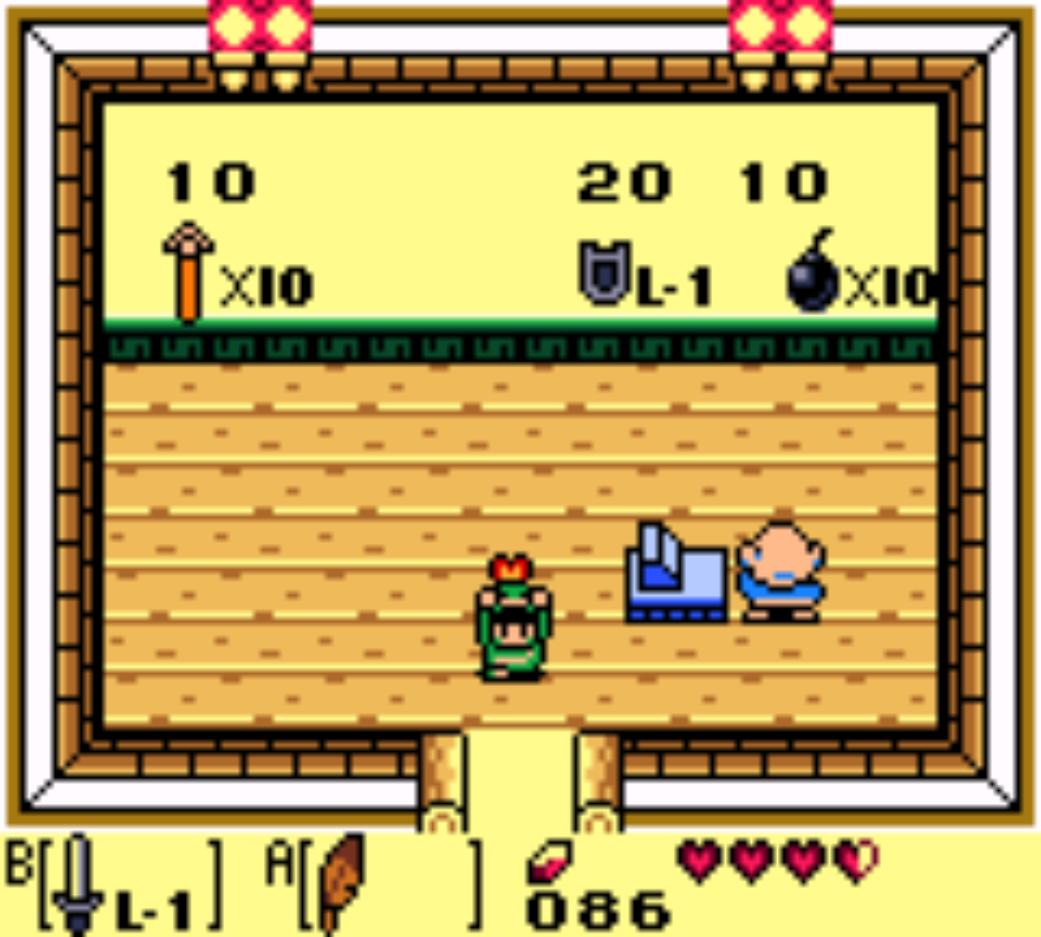
I've also gained a deeper appreciation for all of this game's smaller details. Like, I just noticed that Prince Richard is actually the guy from The Frog for Whom the Bell Tolls and not a random vampire with frogs in his house. The cameos by Wart and a Shyguy from Super Mario Bros. 2 are cute reminders that Koholint Island is not what it appears to be. Oh, and how could I forget Link lifting Marin over his head while the "item-get" jingle blares away. This entry had a lot of fun with the fourth wall. One other thing: the shop. If the "999" didn't give it away, I was never struggling for rupees. Despite this, I was always stealing from the shop. That probably says many things about me as a person, none of them good. Oh well.

When you're "low" on health and slashing a bush is too much trouble.

All in all, The Legend of Zelda: Link's Awakening is one damn good game. More than that, it serves as a stalwart reminder of what drew me to the series in the first place. There's this great sense of discovery when walking from one screen to the next. It's hard for me to describe, but it's something that I've always missed in the 3D games. Maybe it's because oftentimes they rely on taking control away so that the camera can point at objects of interest. Then again, I could just be that type of gamer who's tired of always moving the right analog stick and locking onto anything that breathes. Whatever the case, this entry in the series has aged miraculously. Try to replay it whenever you can. You definitely don't want to catch yourself saying shit like "30+ years"... 

Tuesday, April 15, 2025

2025 Special - Arcus Odyssey

In ancient times, there was a Sorceress by the name of Castorina. She sought the destruction of the world. Total annihilation, remaking it in her image, all the usual stuff. Her plans were ultimately foiled by Leaty, the good witch of the north, who banished her to the realm of darkness. Finally, as insurance in case the Sorceress ever returned, a legendary sword called The Power of Leaty was forged. Huh. I get that Leaty is the sole reason why the world hadn't succumbed to an eternity of destruction, but what an awkward name for a sword. Alright, fine. I'll stop with the lame jokes. Arcus Odyssey, the 1991 action-adventure by Wolf Team, deserves a lot more respect than that. Point is, Castorina is back and none too thrilled. It's time to save the world yet again.

Right after choosing a 1 or 2 player game, you (and a friend?) are greeted with the choice of four heroes. Naturally, I've decided on Jedda Chef. He's a swordsman befitting the 2025 Special so- ehh!? You've got to be kidding me. I've seen a lot of goofy names over the past few months, but Sir Chef over here takes the cake. Each of the four characters have a ranged attack. Its power and coverage increase whenever the player picks up a red crystal (up to three times). One of the delightful aspects is that everyone can move while shooting. There aren't very many occasions where it's in your best interest not to shoot. Enemies respawn ala Ninja Gaiden, so go crazy and stay alive. Everyone also has access to five spells. The cost/effectiveness varies wildly. Oh, and holding down the fire button creates a projectile-blocking shield. Don't underestimate the usefulness of this technique. 

Let me emphasize that despite the overhead perspective and somewhat similar core mechanics, this is not a Gauntlet situation where the four heroes are mostly the same in terms of strengths and weaknesses. In fact, I've made things harder on myself by going with the choice. Mr. Chef's regular attack has meager coverage and requires some heavy button-mashing to destroy bosses. His level 2 spell is pretty strong, crushing most bosses in 1-3 hits. However, late game adversaries require the level 4, which is expensive and tricky to use. The crazy part is that even as the worst character, he still kicks ass. Everyone in this game is just that wicked-strong. Erin, the lady with the flail, can kill most bosses with one swing. Diana is an archer with a level 1 full-healing spell. Bead's regular attack ensures that most foes aren't alive long enough to appear onscreen. 


I'm going to run with an assumption here that Wolf Team intended for each character to be ultra-powerful. They wanted everyone self-sufficient, lending the player enough allowance to approach the game however they choose. Basically, if you're confident in your gamer abilities, you can rush through Arcus Odyssey without hunting down items. Newcomers or those seeking a more relaxed adventure are free to explore, gathering whatever's necessary to defeat Castorina. This setup is also a boon in two player mode. If there's a skill-deferential, then you or your partner can grab the items. Nobody is forced to steal from each other just to survive. Besides, passwords are handed out after every level. This is a game intended to reach a wide audience, while still allowing the maniacs to play their own way (no items, no continuing, etc.). 

On my first couple play-throughs, I was initially put off by the level-design. The stages are often labyrinthian in design, requiring multiple objectives or key-items to complete. Imagine feeling put off that Wolf Team wanted some adventure in their action-adventure game. Yeah, this was something that I had gotten over after a bit more playtime. Each area is usually small or focused so that players aren't wandering around for very long. The few NPCs generally say everything you'll need to know. If you have to do a lot of running around, then you're likely going to stumble upon powerful stuff like invincibility and full-heal potions. Respawning enemies can be troublesome, especially for the one or two Chef fans out there, but even the longest stages shouldn't take more than 10 minutes to complete.


Indeed, this is one of the shorter games I've reviewed this year, and that's fine. The multiple playable characters as well as support for different play styles make this an easy revisit. There's a decent breadth of variety in both locales and fiends. It's an adventure that feels sufficient, making full use of its limited runtime. Boss battles can be tough, but only if you approach them with the intention of playing fair. Personally, I reveled in the fact that so many of them can be killed outright. The developers didn't skimp on the power in their power fantasy, and I totally admire that. Perhaps, I'd have felt differently at another point in my life and demanded that every encounter be a life-or-death slugfest as finely tuned as the average Cave shmup, but... Nah! I'm going to savor this.

Arcus Odyssey is yet another Sega Genesis game that is prone to slipping through the cracks and getting ignored by even the hardcore gaming community. I mean, I'm absolutely speaking for myself here. This is the first time I ever seriously played the game. Wolf Team did some great work here. A rad intro, a sometimes-silly localization, and Motoi Sakuraba's classic Mega Drive sound round out the package nicely. 

Give it a go. 


Monday, April 14, 2025

2025 Special - Radia Senki: Reimeihen

Released way back in November 1991, Record of Radia War was a really interesting departure for Tecmo. It is, by my recollection at least, one of the first party-based Action RPGs made for consoles. Players control the hero and give basic commands to the other members of their party. When they aren't under orders, the allies will attack nearby monsters. There are also a handful of available spells and items for when circumstances demand them, but most anyone can get by with just restoratives. The combat system might be a little too basic by today's standards, but it's functional and entertaining.


Now is it entertaining enough to last eight or so hours? While considering the answer to this question, I can't help but stumble back to the past. Decades ago, at a time when I was hunting for anything that received a fan-translation, I gave Radia Senki: Reimeihen a shot. After ten minutes of playing, I concluded with a dispassionate "This is neat." and then dropped the game immediately afterwards. Looking back, it was rude of me to so casually dismiss what was clearly an innovative game. Now, after seeing the adventure through from beginning to end, I'm left with the possibility that perhaps my younger self made the right call. Excuse me, I meant to say the right call for him, it's his opinion after all...

...There it is again, the sickening feeling that I've just wandered into another moment of existential dread. 

Although I'd love to say that my tastes have become more sophisticated with the passage of time, it's hard to ignore the obligation I placed on myself to see all of these sword-guy-games to the end. For some absurd reason, I'm not inclined to believe that my opinion has actually changed. A ridiculous thought, considering all past-Gabriel did was string a few words together. However, I've had both past & present opinions laundering in the abyss of my skull for a little while, and the words "This is neat." continue to appear. 


Alright, so I spent 8 hours on this game, clearly there should be substantial things to talk about. Maybe an explanation of what exactly happened in all that time would help. The story being a potpourri of kidnapped princesses and MacGuffin chasing isn't substantial, so let's look past that. Well, there was a lot of fighting. Combat is the one constant throughout this adventure. The bulk of exploration occurs in dungeons, and even then, it's mostly just a detour or three to grab treasure. A "lost woods" dungeon is probably the closest Radia Senki ever gets to a puzzle, which is mostly just trial & error. The solution to every other problem involves repeated stabbings, which would be fine, but what's here isn't enough to last.

Let me be clear for a moment; while battling enemies is "functional and entertaining", there's simply not enough meat to it. Like any other RPG, enemies grow in strength and durability the closer the hero gets towards his ultimate goal. Sadly, their strategies never evolve beyond "find someone to attack". A boss might have a gimmick like teleportation or cloning, but it's never enough to save them from being overwhelmed and slaughtered. Still, there is joy in ping-ponging hapless fiends between allies or reenacting the Ides of March on a larger foe. Every encounter taking place in the game-world and not in a separate battle-screen is actually pretty amazing for the NES. Though it can rarely have an adverse effect, such as aerial enemies deciding to fly out of the party's reach.


While the combat leaves behind a mixed impression, other aspects of the game hold up quite favorably. The "advice" feature is one of the standouts. Choosing it prompts a brief conversation between the main characters where they outline their destination and how to get there. An invaluable feature for when the player is coming back to the game after a long hiatus and doesn't remember where to go next. Barring some flicker, the visuals and performance are solid. Being able to rest and save the game on any bed is also a lovely convenience.

If there was ever a timeline where Record of Radia War had released in the west, and kid-Gabriel had gotten it for a gift, he'd probably still be defending it today. This is not a deep game, but it is ambitious and... neat. An impressive effort from Tecmo.


Saturday, April 12, 2025

2025 Special - Golvellius - Valley of Doom

One of the many games that I finally played through for the first time this year was The Guardian Legend. Let me just go ahead and say that it was really enjoyable. There is an inherent coziness to exploring a hostile facility in search of carnage and power-ups. The shmup stages were also totally Compile, with a wildly uneven level of difficulty. I was either drowning in health restoratives or clutching my nether regions trying to take down a boss with hardly a pixel of life. Still, it was a great time and by every metric a certified NES classic. Sadly, that's the closest to a review you'll get out of me, since this game doesn't meet the 2025 guidelines. The protagonist is a woman. Also, her main weapon is a gun...or is it an arm cannon? Whatever. It shoots bullets and isn't shaped like a sword. What a shame.


"Oh, if only Compile had made a game that fit my arbitrary criteria." I wonder aloud. Somewhere in the world, the finger of a monkey's paw curls in response. Compile did in fact develop an action-adventure that stars a guy with a sword. The only catch is that...well, it's a very individual game. I was originally planning on calling it unique, but individual sounds so much more exclusive. Here's the product of developer that clearly knows their stuff but played around with the rules to create a one-of-a-kind experience. There will be friction, and sometimes pain. Not too much pain, mind you. This is still one of the fluffier action-adventures out there. Deaths are expected, but not overly punishing. Still, you might become the butt of some practical joke.

Before going any further, I have to make a confession. I've been writing these reviews for a while, yet not once have I ever mentioned one of the titans of the genre: The Tower of Druaga. Namco's 1984 arcade hit spawned damn near every "guy-with-a-sword" adventure that I've so readily taken for granted. Seeing as how I'm now talking about two games that aren't the subject of this review, I'll try and keep this short. Basically, the player is tasked with climbing 60 floors to save a princess. Climbing floors is the easy part, since it's just a matter of grabbing the key and reaching the exit. The challenge - besides the monsters stalking the halls - is the fact that there are treasures you need to find. Each floor contains hidden treasure, but you aren't given any clues on how to find it. That's by design. Players are obligated to experiment, take notes, and share any information they've gathered with friends. This feature is likely what made The Tower of Druaga such a massive influence. Most other games expect you to know the answer, while this demands you to find the question. 

The PC-Engine version of The Tower of Druaga.

While I'm not particularly familiar with the game - though I spent a little time with the PC Engine version - understanding it is helping me see the genre in a new light. Everyone making action-adventures in the mid-to-late 80s had Druaga on the brain. Sure, they'll make concessions to attract a wider audience, but they intended for their games to have little to no clues, leaving players to figure everything out on their own. Now bear in mind, just because the player is thrown into the deep end, doesn't mean that they have to drown. There is a logical throughline that helps keep all of these games functional and entertaining. For example, in The Legend of Zelda, every screen contains one secret. In Neutopia, every screen contains one secret. Golden Axe Warrior? Yes, there is one secret in every screen. It is this logic that leads to the schoolyard conversations, the notes and maps shared between friends. One screen, one secret. 

Which finally brings us back to Golvellius - Valley of Doom. The goal is quite simple. There are seven crystals and a princess to find, so get to work. Where Compile's game sets itself apart is that it plays with expectations. Upon hitting the start button, the player is treated to an introductory dungeon, and it's a side-scroller. Kelesis, the hero, jumps and swings a sword. He'll make short work of everything that gets in his way, which is all well and good. However, the intro dungeon establishes more than just "stab anything that moves". Take note that Kelesis doesn't turn around when he moves to the left. The screen doesn't scroll left either. This will become important later.

Get used to farming mice for easy cash.

Upon reaching the overworld, players should quickly familiarize themselves with the "one screen, one secret" rule. Indeed, they have to adhere to it, because their life depends on it. Kelesis starts off incredibly squishy. Monsters spawn in almost every screen, and there is no end to them. The only way to survive is to obtain power, and to obtain it quickly. Naturally, power takes many forms, including potions that increase their maximum life. However, everything has a price. If you don't have enough gold, then you either have to kill baddies for a bit, or purchase bibles to increase the size of your wallet (which means killing more baddies to fill that wallet). A not insignificant chunk of this game is spent farming. Maybe it gets repetitive for some gamers, but I never had a problem with it. Then again, I'm also that guy who seeks out the best spots to efficiently hunt monsters for their rare drops in all those Igavanias. 

Most of the time, finding the one secret in a screen is a simple task. Many of them are uncovered just by killing a couple of nearby monsters. Keep in mind that the secrets unearthed through such a menial task are not often valuable. You might stumble upon a fairy chilling with a sno-cone. Another fairy might offer some encouraging words. A few just laugh and send you on your way. Though you'll never be robbed or attacked for finding a secret, your pride is sure to take a mild beating. Still, it pays to be thorough. Hints to the valuable treasures can be uncovered, even if a couple of them are... really not helpful at all.

If you've played through Golvellius - Valley of Doom, then you're familiar with the blue rock puzzle. For everyone else, take a gander at the following screenshot.
 

You can tell just by looking at this screen that there is an important secret. A nearby fairy says that you should "push the blue rock". Seems pretty simple, right? Just give these... 24 rocks a push in whatever direction while being endlessly swarmed by frogs and bats. Something good is bound to happen. Actually, that's a lie. I'm not sure if this was supposed to be a joke that got lost in translation, or it was a reference to the original MSX version of the game. In any case, what you're supposed to do is attack the rock with your sword. It's a pretty nasty bit of misdirection, especially since the game has only just started. If you didn't know that you're supposed to use your sword on anything suspicious, then you could end up stuck here. Then again, hitting up the internet for the answer only takes a second, but you get what I mean... I think. Anyway, this is the worst puzzle in the game for the wrong reason, the only blind spot in what is usually a very logical adventure.

The level of difficulty is also what I'd call very individual. The first several minutes will be rough. Kelesis is almost always getting hurt. He's a large target. You'll be guiding him on frequent trips to the friendly (but not free!) healers. Again, this is to emphasize the importance of grabbing every last health potion and equipment upgrade. Only a true maniac would dream of attempting a low% run. Given enough time, you'll no longer fear death, in the overworld at least. The bosses will remain a threat throughout your playthrough. Be patient and don't overextend yourself when fighting them.


Now I mentioned that an aspect of the introductory dungeon would become important later. That later is right now. When exploring dungeons, the fear of death will be replaced by the fear of setback. Basically, since you can only move forward, the chances of walking yourself into a corner are high. You never get stuck, because leaving the dungeon is as simple as walking backwards and offscreen. That of course means you have to start over, which is enough to strike fear in anyone's heart. If you miss a jump, accidentally set off a trap, or get pushed offscreen by an enemy, then that's a rude little setback, isn't it? The overhead dungeons aren't any less troublesome. They're auto-scrollers and not shy about presenting multiple routes where at least one leads to a dead-end. In fairness, none of the dungeons go on for an especially long time, and you're not expected to have super reflexes to avoid setbacks. Frankly, I applaud their inclusion. They're appropriately absurd, as fitting as anything else in this charming game.

One of the reasons why I never seem to get tired of action-adventures - despite playing through 30 of them in a row - is that there's always something intriguing to learn. Golvellius - Valley of Doom isn't nearly as polished as the best of the genre, but it is a special experience all the same. If any other game tried to pull off half the stuff that Compile did, I'd probably still be complaining about it. There's a lot of heart in this light-hearted take on an established genre. A fine piece of history. Recommended for anyone who isn't afraid of a few setbacks.


Thursday, April 10, 2025

2025 Special - The Magic of Scheherazade

Culture Brain is one of many developers that I admire no matter what they do. Their approach is often a bit strange, low-budget, and sometimes hard to appreciate. Nevertheless, they're always coming up with clever ideas, intriguing concepts, or unique spins on common formulas. Baseball Simulator allowed outfielders to launch into space to catch fly balls. Flying Warriors is basically a Super Sentai mini-series for the NES. My soft spot for a time was Super Ninja Boy on the SNES. An RPG that featured side-scrolling platforming levels, beatemup random encounters, and turn-based boss battles?! That sounds exactly like the kind of game I'd be into. Well, playing it is another story. Over the past 30 odd years, all of my replay attempts have fallen apart almost instantly. 


Then there's The Magic of Scheherazade, an Action-Adventure + RPG. It features a male protagonist who swings a sword in a top-down world, a practically perfect specimen as far as the 2025 Special is concerned. Unfortunately, while I was able to finish a play-through - with ample help from a guide - the experience was mostly unpleasant. Let's break it down a little. The action was serviceable, though subject to unavoidable frustrations. The spirit of a grand adventure is there, yet it's aged considerably by trial & error obstacles. A bevy of design-decisions caused my tolerance for the RPG portions to fall into oblivion. By the end, I had somewhat of an idea of what Culture Brain was going for, but I'm just glad it's over.

The basic premise is that the evil wizard Sabaron has captured princess Scheherazade and her family. You're the unnamed descendant of Isfa, who fought Sabaron... and lost. Stripped of all memories and flung to another time period, you'll have to recruit friends, obtain powerful artifacts, and crush the demons trying to conquer Arabia. By the way, don't be like me and choose a dumb name for the protagonist. I've read at least a third of the 1,001 Arabian tales and don't recall seeing a single person named Larx, yet that's the name I chose for the protagonist. Boggles the mind, doesn't it? Anyway, what follows is an adventure that encompasses five chapters. Each chapter consists of an overworld with a handful of towns and dungeons to explore. Standard stuff.


Moving from screen to screen and besting whatever baddies appear onscreen is a simple affair. Well, mostly simple. You'll have to assign actions and spells through the pause menu. It'll become second nature before long. Depending on whether you chose to be a Fighter or a Magician, your skill with the sword and rod will change. 90% of the time, it's better to be a Magician, negating one of the reasons why I chose this game for the 2025 Special. Oops! Seriously though, the rod is just easier to use, especially on enemies that like to keep their distance. Outside of specific circumstances, of which there are a surprisingly large number, it's really difficult to die in battle. The healing spell 'pampoo' is cheap, the hero can carry 10 health-replenishing breads at a time, and demons are easily defeated in a few hits.

A large number of specific circumstances is just a roundabout way of saying instant death. In time, you'll face unique demons that cast bizarre spells, turning you into a menagerie of oddities. Get touched by an enemy while in this sorry state? Death. Falling into water or lava is also fatal, so watch where you're walking. Another more common problem is that bosses have unavoidable spells. They tend to fire them every few seconds. The loss of health certainly stings, but the fact that control is taken away for seconds at a time will drive you crazy. Salamander, the 4th boss, is an especially cruel example. He's always pausing the action to toss a fire spell or slink underground, restoring his health in the process. Adding to the nonsense is the fact that Salamander is fast. Just landing hits on the giant jerk becomes a soul-draining experience.


I won't spend too much time on the adventure portions. From what I've read online, Culture Brain USA made the game world more linear, which is a plus in my opinion. The overworld and dungeon layouts get repetitive, so the less time getting lost the better. There are some aspects they could've excised completely, such as hidden pitfalls. There are only 5 or 6, but any number greater than zero is still too many. Other than that, figuring out where to go and what to do isn't that tough.

However, you won't want to risk getting lost at all, because several screens place you in a turn-based battle when you try to leave. Yeah, a turn-based battle, with your own party and everything. All the friends you recruit have their own abilities, and there are different formations for everyone. Some formations are better for certain encounters than others, but it's never going to be a done deal. Fact of the matter is that there are a large number of specific circumstances that'll prevent you from enjoying the battle. The enemy party might start off with a special attack that instantly kills your allies, or even you. Battles are also slow, a resource drain, and often not rewarding enough to justify the trouble. Use the 'ramipas' spell to lessen encounters and try to run away from every fight. Your sanity will thank you.

The more time I spent in The Magic of Scheherazade's world, the less I wanted to engage with it. What probably could've been an endearing cross between The Legend of Zelda and Dragon Quest became an annoying slog. Regrettable. 


Monday, April 7, 2025

2025 Special - Ys 4: The Dawn of Ys

Dammit!
I've tried to write over a dozen introductions, and every single last one of them sucked. If you need an intro to this review, then I'm afraid you'll have to make one up in your head. In fact, I'm going a step further and starting off with the conclusive statement:

Ys 4: The Dawn of Ys is peak, absolute cinema, top tier, etc. Pop this sucker into whatever hardware you're using to play PC Engine CD games and you'll be treated to one of the finest Action-RPGs of the entire 16-bit era. If you haven't dropped everything to play this game, then I don't know what to tell you. Honestly, it's like 32 years old now. The onus is supposed to be on my dumb ass for ignoring it for so long.

Okay, that's sort of an intro. Imagine a better one if you want, but I've got to move on. 


First impressions being what they are, I expected Ys 4 to be a retread of Ys 1 & 2. They are in a way, with all of the references and outright fanservice. The introduction is also slightly uneven. One of the first dungeons is a retread of Ys 1's abandoned mines. Winding passages, limited visibility, and that sinking feeling that maybe I should've waited a couple of months to give the painful memories a chance to heal. Next thing that happens, Adol is in a fire cave helping out Karna the hunter. She's mopping up everything in sight and stealing all of the experience. Clearly the developers were throwing around some new ideas, but if this was a sign of things to come then...  Okay, fine. I'll stop pretending that this could any in way be construed as a negative review. Besides, my hand was clearly shown mere sentences in. Whatever tinges of regret I could've felt were instantly wiped away after a little more play time. 

Let's start with the bump-combat, which is still as genius as ever. This entry introduces a huge innovation; Adol can now walk in eight directions. Recalling my experience from Ys 2 Chronicles +, I wondered if approaching enemies while moving diagonally would be overpowered. It turns out that isn't the case. The different angles of movement are absolutely a boon when it comes to maneuvering around danger, but victory in battle still requires that you strike the side of an enemy. Hitting them dead center still does damage, but there's a chance you'll get hurt in the process. If it wasn't already painfully obvious from previous entries, chances are often not worth taking. Running headfirst into a crowd of goons is guaranteed to Adol killed, so don't try to be too heroic. Then again, threading the needle and slicing through multiple foes at once will never not be thrilling. 


Much like their forebears, the enemies that stalk the forests and temples of Celceta don't do much besides walk in four directions and hit like a freight train. Well, that's not entirely true. Many of them move at different speeds, even out-pacing Adol in rare circumstances. A couple fling projectiles whenever they get the chance. The worst of them, as far as my play-through is concerned, has to be the invisible goons. These jerks don't even cast a shadow. The hero getting ambushed and consequently obliterated while resting makes for a nasty jump-scare. Tools that reveal these goons' presence are available, but usually it's better to just keep moving. Consider it a bonus when a previously unseen adversary dies by your hand.

On a sidenote, since this time is most likely the last that I'll ever use the word goon, I have to show my appreciation for the huge variety of goons. We've got Godzilla rejects, cuddly Godzilla rejects, scorpions that are 90% tail, giant two-legged rats, and all sorts of other abominations. This to me is what gave goon meaning. Hundreds of foul creatures with misshapen forms that defy reason, yet there is heart to all of them. This is most apparent when Adol uses the alter magic. Disguised as a fellow goon, the adventurer can converse with any fiend he bumps into. It's a fun having this Ys 2 spell back. Listening to everyone talk about how much they hate that red-haired guy is always a treat. 


Oops! I probably could've mentioned earlier that there are usable magic wands. Again, Ys 2 fans will notice some familiar spells, such as fire and warp. Shield also returns, a strong tool as long as MP remains. A set of magical rings adds further dimension to every encounter. Particularly useful rings, such as Timer, slow the walking speed of every adversity. This ring probably would've made a clever method for setting the game's difficulty, if it wasn't found so very late in the story, but that's just nitpicking. There are some other items that offer unique effects. The most powerful of them all has to be the Samson boots. When Adol slips these on, his speed drops to Rolan's Curse levels, but he can kill any goon in one hit. A worthwhile trade for a primo grinding experience. 

Now as far as concerns the bosses of Ys 4: The Dawn of Ys... I can't say "Wow!" enough. There is not a single weak fight in the entire game. Every archfiend encounter is suitably epic, requiring every last ounce of the player's skill and tenacity. The earliest fights will help you get reacquainted with the basics, and everything beyond escalates the intensity. Boss battles are often complex too. Opportunities to attack them aren't nearly as common. They'll utilize a wide variety of attacks. Patience is the most important weapon in your arsenal, especially when bosses are close to death and respond with increased aggression or new attacks. Noteworthy fights include the one just below. Trying to strike this bug-like creature while it's swirling around is tough, but every attempt will bring you closer to taking it down for good.


That's not all though! Multiple bosses can only be defeated with the fire and freeze spells. The shmup-like mechanics are back in a big way. These fights are seriously intense, utilizing a bevy of projectiles or ornate patterns to blast the life out of Adol. The amount of variety on display here is staggering, far outclassing anything I've seen in the other 16-bit games. Most importantly, the battles are fair. I'm not losing because of wackadoo hit-boxes or absurd RNG. I'm losing because I need more practice. Every single boss is a legitimate challenge, providing an immense wave of satisfaction to anyone who can defeat them. If it ever feels like a lot to deal with, just remember that as far as Ys goes, leveling up one more time can make a big difference. 

An Action-RPG that takes less than ten hours to complete shouldn't feel this epic, an yet Ys 4 delivers here as well. The forest of Celceta hides a wide array of locales to visit, each having its own atmosphere. Level layouts are often conventional but arranged superbly. There are also numerous instances where the developers got particularly creative, such as the brief M.C. Escher-inspired dungeon. To put it simply, you won't feel like you're just running through nondescript grasslands or hallways over and over again. Later dungeons dial up the mazes, but even the worst of them tend to be mercifully short. The excellent artwork and amazing dub ensure that there will always be something to look forward (as if the fantastic bosses weren't enough).


Now as for the complaints... Huh. That's odd. There must be something to complain about here. Hmm... Really, I hate to say it, but I can't think of anything that I didn't like about this game. Yeah, the beginning was slightly off-putting, but that's likely due to me playing Ys 1 & 2 and Ys 4 so close together. That minor detail about getting the Timer Ring so late doesn't merit a drop in my (nonexistent) number score either. Gosh. Everything here is just right.

To reiterate: peak, absolute cinema, top tier, etc. 

Give it a try if you haven't already. 


Saturday, April 5, 2025

2025 Special - Crusader of Centy

Warning: There will be spoilers ahead.

During your 14th Birthday party, your mother gives you a gift. It's your father's sword and shield. Sometime ago, he died saving the town of Soleil from monsters. Though your mother is hesitant, knowing that she could lose her son the same way she lost her husband, there are traditions that have to be followed. All young men are obligated to take up arms in the ongoing fight against monsters. Without a word, we set off on a journey to protect Soleil and its surrounding lands, using our father's weapon to strike down anything that get in our way. Even if it isn't immediately obvious, there is something off about Crusader of Centy.


This 1994 action-adventure by Nextech is filled with conscious decisions. If you ever feel unsettled by your adversaries being cute or even outright comical, that's because it's intentional. Underneath the almost nauseatingly fluffy aesthetics is an introspective and often poignant game. It's also making for a surprisingly difficult review, if I'm being honest. Part of the problem is that I'm attempting to write this when I had only just finished the game last night. It usually takes at least a couple days for my brain to neatly organize everything. Everything right now is still a jumbled mess. Further complicating matters is that this just had to be one of those games that required me to think about it. Imagine the nerve! I have to take into consideration the themes. Themes!? I've written what feels like a thousand reviews. I don't look for themes! I look for whether or not the sword hits things good.

While I figure out whatever it is that I'm trying to say, let's start with the basics. Right from the jump, Crusader of Centy is one of those titles that just feels good to play. The protag's walking and sword-swinging abilities are on point. Near Soleil, there's the Rafflesia Training Grounds, where newbies can get accustomed to the controls. Rafflesia. That's a pretty-sounding name, isn't it? While looking it up - to make sure I had spelled it right - I discovered that it also goes by the name "stinking corpse lily". Odorous, parasitic, and nowhere near as pleasant as the name makes it sound. Huh. Could've sworn I just said something about conscious decisions. Anyway, the controls are nice and snappy, but also unique. The player-character doesn't immediately turn when changing directions, so if you're facing north and move east, then he'll face northeast for a split-second. This is something to keep in mind when throwing the sword.


The first technique you learn - after spending the requisite 20 malins - is sword throwing. Hold down the attack button to charge up, release to throw the blade a short distance. I complained about the noise this technique makes in my Crystalis review, but I guess it isn't such a big issue now. The sword throw is required for puzzle-solving and boss-battling, but otherwise there's no real reason to be in a constant state of charge. It's not like monsters are going to ambush the protag at any moment. In fact, unless you're absolutely desperate for cash or want that overpriced health upgrade, there's little incentive to fight. The number of instances that require malins can be counted on one hand. Monsters don't drop health restoratives either, those are usually found in bushes. Nature provides, I guess.

It quickly becomes apparent that the sword throw is meant for puzzle solving. Striking switches that can't easily be reached, and so on. This is around the time the game introduces its other main mechanic: animal friends. The protag can have up to two animals follow him at every time, and they all have talents or special abilities. They're comparable to the items that clog up so many inventories in The Legend of Zelda games. Circumstances that require switching animals occur pretty often but expect to have Flash the Cheetah along for most of the adventure. He doubles walking speed and jumping distance.


Oh! That reminds me. Crusader of Centy has a great jump! Over the past months' worth of these action-adventure games, I've grown increasingly disdainful of jumping. A jump should feel freeing, not a tool of artifice that's required to navigate platforming challenges. Over the course of many other games, I've felt like some poor show dog jumping through hoops. That is absolutely not the case here. Nextech totally gets what makes jumping work. Leaping over obstacles is effortless. Leaping over nothing in particular is natural. I'll also dole out some extra credit to the developer for ensuring that the player can't accidentally walk off of most platforms. It's astonishing how few games in this genre utilize such a feature. 

The first half of your journey is filled with fun and adventure. I don't just mean fun in the sense that it's a fun game (which it is). The fun is in visiting strange new lands, making numerous friends, and getting involved in quirky situations. There is a lurking undercurrent though. One, the "hero" that you'll often run into. This single-celled brute rushes around attacking indiscriminately. You're his target at one point. Initially, you brush it off. After all, you were a monster at the time. A completely harmless slime, but still... a monster. Other events occur that you might not give too much thought to. Their significance doesn't become apparent until visiting the floating land above the Tower of Babel.


With some newfound insight - and a pair of time-traveling shoes - you'll find yourself revisiting previously explored lands. Gone are the thrills of discovery. Instead, you bear witness to some painful truths about this world's history. The second half feels much more like an adventure game, where that sword you were throwing with reckless abandon has become a tool made exclusively for solving puzzles. Granted, some of those puzzles involve striking an archfiend's weak point, but the intent is still there. The main point is that there is a lot less fighting and a little more introspection. You'll learn to depend more on your friends, making full use of their abilities to progress. It's a very thoughtful take on the hero's journey. 

Crusader of Centy isn't especially difficult. If you make an effort to seek out all of the health upgrades, your chances of even approaching death are pretty slim. Again, this is all by design. Nextech cast their net wide in the hopes of reaching players of all skill levels. I'd say they did a remarkable job there. Hell, everything about this game is remarkable. It's a unique and wonderful piece of work. The localization is pretty rough though; dated 90s references and misspellings galore. 

Highly recommended.

Friday, April 4, 2025

2025 Special - Crystalis

I can't remember if it was 1990 or 1991 when I played Crystalis for the first time. Thankfully, I can remember the first time I completed this game; April 1st, 2025. Yet again it's taken me over thirty years to finish a classic. How embarrassing! It's not a particularly long, difficult or complex game either. If you'll allow me to indulge in an obsolete term, SNK's sole Action RPG is what would be classified as the perfect rental. Or, for the kids who can't wrap their heads around ancient history, then it's the perfect weekend video game. The kind where you can immediately pick up its basics, be transported into another world filled with adventure, and obtain at least one pleasant memory to hold onto. I have some serious guts making such a claim, especially considering I just finished it for the first time a few days ago.

The earliest SNK games on the NES were... bad. Awful, even. Maybe there's somebody out there who had a fondness for Athena, or the terrible port of Ikari Warriors by Micronics, but that somebody positively wasn't me. Their output changed dramatically from 1988 to 1990. Iron Tank, Ikari 3, Guerilla War, and naturally, Crystalis. I might be missing one or two titles, but that is one solid lineup. Iron Tank is a superb adaptation of TNK III, with added features such as multiple paths. Ikari 3 took a terrible arcade brawler and made it work. Guerilla War almost feels like a new game, one that I prefer over the arcade original. I'd like to imagine some alternate timeline where SNK never created the Neo Geo. Instead, they'd find success in the Crystalis franchise as well as other original products for consoles.

Seeing as how I've covered 25 action-adventure games over the past month, one would assume that I'd have gotten sick of them by now. Seriously, just how many sword-swinging dudes can I put up with before the walls start crumbling. Quite a few apparently, provided they maintain some level of quality. The subject of today's review is one of them. Crystalis works on multiple levels. It's instantly engaging, with a tinge of depth to keep the maniacs enthused. The power fantasy extends beyond stabbing slimes to incorporate mastery of the elements; summoning screen-filling explosions, waves of tornadoes, all that other fun stuff. Though there is quite a bit of cave exploration, the game knows when to get creative. Players will see and do a lot in a short but sweet period of time. Again, a perfect rental weekend video game. 


This game has controls that'll instantly activate anyone's neurons. Moving around is smooth with a weapon that is sufficiently punchy. The protagonist stabs very quickly, rewarding fans of button-mashing and auto-fire. Most important is the charge attack. You're going to be charging almost all of the time, and yet there's just the right amount of audio and visual feedback to keep it from being annoying. You'll see and hear the cues, with neither getting in the way of your experience. It's a little detail, but one that I really appreciate. No really, I've been playing Crusader of Centy, a game with a charge move of its own, but it makes this "wruhwruhwruhwruhwruh" sound that drowns out the fantastic music. If only Nextech took a lesson from SNK, am I right? Anyway, the charge attack in Crystalis is great. There's this wonderful rhythm to firing off several projectiles in succession. There's also something of a meta wherein a level 2 charge is maintained just enough to avoid reaching level 3 and potentially wasting MP. I'm a maniac for this sort of stuff.

There are a couple points of contention to this game that I want to visit right now. First is the mandatory grinding. Well, maybe it isn't grinding depending on how you approach it, but it's definitely mandatory. The protagonist will be locked out of one area if they aren't the sufficient level. There could also be an instance where they can't damage a boss if their level isn't high enough. It has annoyed enough people to see a romhack or two, but truthfully, I didn't have a problem. There are a couple primo spots for getting the grind over and done with, my favorite being the plains near the Goa Fortress, where I can unleash blizzards on all of the hapless bow-carrying soldiers. This is one of the few instances of grind time that I don't get tired of.


The second is that enemies are often immune to one or more swords. There are four elemental-themed blades to swap between, and you'll find yourself doing just that to utilize their wall destroying or bridge-building powers. That's all well and good but having to switch weapons to deal with regular enemies might be a sticking point for some. Understandable, but it works for me. Swapping swords never takes long, and enemies still can still be pushed back by a weapon they're immune to. Towards the end of the game, I was running past a lot of monsters anyway (being max level probably contributed to that).  

With those two out of the way, let's get back to the stuff that unequivocally works. The world of Crystalis has caves and castles, but it also has dolphinback riding. There's a toxic forest, mountains to climb, a town where you have to disguise yourself as a woman, etc. Something creative is always happening. You see what the game is going for, spend enough time with it for the "oh that's nice" feeling to settle in, and then just like that it's over. Pristine design. Dungeons are also kept at a very manageable length. Paths branch and there are a couple dead-ends, but nothing too nasty. I'm sure the word pacing has lost all meaning by now, but it's so good here that I have to use it.


There's more to the enemies you'll face than just their elemental immunities. The variety here is really good, with some skillful usage of status ailments. Mutants in this world can poison, paralyze, or petrify. A couple particularly cruel fiends can turn the protag into a monster, greatly hindering their survivability. I prefer this to some games that have a poison dungeon or something and then just forget ailments ever existed. Enemies always having some means of getting under your skin keeps fights interesting. 

Boss-battles tend to be uneven. The toughest nemesis in my play-through was probably the first General, though that could be attributed to the path to his lair being filled with resource-dwindling encounters. Most of the other battles merely consist of dodging a few attacks and then responding with some level 3 charged blasts. This becomes extremely apparent towards the end of the game. The final bosses do tons of damage but can be killed with a couple bolts of lightning. Yeah, not the unequivocal good that I would like to have seen, but the faster something dies, the less I have to complain about. Let's chalk that in the win column.

Crystalis is a classic, a must-play for afficianachos or whomever can appreciate a good-ass game.